What Is AEO? Answer Engine Optimization Guide
You publish a helpful article, it ranks decently on Google, and then someone asks ChatGPT the same question your article answers. The AI gives a clean paragraph reply. Your name is nowhere in it. The click you would have earned never happens.
More people now ask a question and accept the answer an AI hands back, without ever scrolling a page of ten links. If your content is invisible to those systems, you lose traffic you already worked for—and you have no idea why your rankings look fine while your visits quietly drop.
Most search results explaining this topic stop at a definition and a buzzword. They rarely tell you how AEO actually differs from SEO, what you need before you start, or what it costs an Indian business to do properly. This guide covers what AEO is, how it compares to SEO and GEO, what to prepare, the steps in order, what goes wrong, and who should skip it for now.
What is AEO answer engine optimization?
AEO answer engine optimization is the practice of structuring and writing content so answer engines can extract a direct answer from it and cite your brand as the source. Answer engines include ChatGPT, Perplexity, Google AI Overviews, Gemini and Bing Copilot. Instead of only competing for a ranked position, you make your content easy for a machine to lift a clean, correct answer from.
Traditional search sends a user to your page. An answer engine reads many pages, synthesises one reply, and may name a few sources. AEO is how you become one of those named sources. That means writing self-contained factual sentences, answering the exact question early, and marking up your content so the meaning is unambiguous to software.
AEO vs SEO: what actually changes
AEO and SEO share the same foundation: quality content and a technically sound site. They work toward different endpoints. SEO aims to rank a page in a list of results. AEO aims to have a specific answer extracted and attributed. You cannot do good AEO on a site with broken structure, so SEO is not replaced. It becomes the base layer.
The practical change is in how you write and format. SEO rewards depth, keywords and links. AEO rewards clarity, direct answers near the top of a section, and clean data an engine can trust.
| Aspect | SEO | AEO |
|---|---|---|
| Goal | Rank in the results list | Get answer extracted and cited |
| Target | Google, Bing crawlers | ChatGPT, Perplexity, AI Overviews, Gemini |
| Winning format | In-depth pages, backlinks | Direct answers, structured data, clear facts |
| Success metric | Position, clicks | Citations, brand mentions in AI replies |
| Writing style | Keyword-rich, detailed | Question-led, self-contained sentences |
AEO is not a replacement for SEO. If you drop SEO to chase AEO, you lose the crawlability and authority that make an engine trust you in the first place. Treat AEO as an extension you layer on top of solid search fundamentals.
AEO vs GEO: the difference people keep asking about
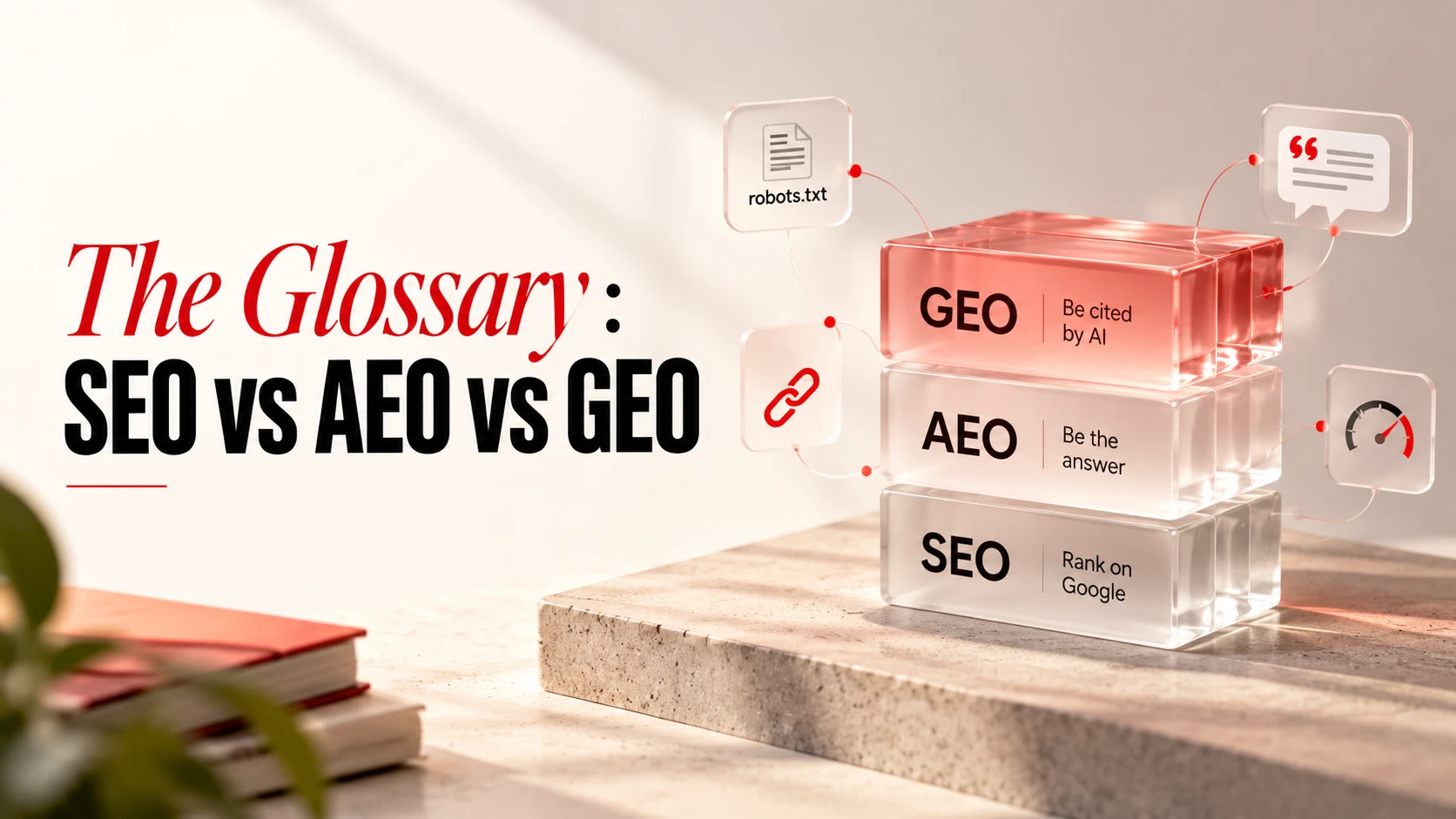
AEO and GEO overlap heavily and the terms are often used interchangeably. There is a useful distinction: AEO, answer engine optimization, targets systems that return direct answers, including featured snippets and voice results. GEO, generative engine optimization, focuses on large language model outputs, the generated paragraphs from tools like ChatGPT and Gemini.
In everyday work the tactics are similar. Both want clear answers, structured data and quotable facts. If you do well for one, you help the other. You can check where your site stands on the generative side with a tool like the GEO readiness checker, which flags gaps in how machine-readable your content is. Most Indian businesses do not need to agonise over the label. Do the work once, and it serves both.
What you need before you start
AEO built on a weak foundation just makes weak content easier for a machine to ignore. Check that these are in place first:
- A crawlable website with clean HTML and reasonable page speed. Run your pages through a technical SEO checker first.
- Content that genuinely answers real questions, not thin pages padded for keywords.
- The ability to add structured data, either through your CMS, a plugin, or a developer.
- Clear, accurate facts about your business, product or service that stay consistent across your site.
- A way to measure brand mentions, since AEO wins often show up as citations rather than clicks.
If you run WordPress, most of this is achievable without code. On a custom build you will likely need a developer for the schema part.
What AEO costs in India
AEO costs range from almost nothing in tool fees to a meaningful content and engineering investment, depending on how you approach it. There is no licence to buy and no regulator involved. Your real spend is time, writing quality and, if you outsource, agency or freelancer fees.
| Approach | Typical cost | Best for |
|---|---|---|
| Do it yourself with free tools | ₹0 plus your time | Solo founders, small sites |
| Freelance writer plus schema help | ₹15,000 to ₹50,000 per month | Growing businesses |
| Dedicated AEO or content agency | ₹50,000 to ₹2,00,000+ per month | Funded startups, larger firms |
| Software subscription | Varies by plan | Teams wanting workflow and tracking |
You can start AEO for free. The money buys speed and consistency, not a secret the tools hide. Confirm current pricing with any provider before you commit, and start small so you can see whether citations actually rise before scaling spend.
Step by step: how to do AEO
Step 1: Find the questions people actually ask
Start with real questions, not keywords you guessed. Pull from Google's People Also Ask box, from what customers email you, and from support tickets. A question explorer surfaces the phrasing people use so you write answers to questions that get asked, not ones you invented.
Step 2: Answer the question first, then explain
Open each section with a direct, complete answer in 40 to 60 words, then add detail below it. Answer engines lift that opening. If your answer is buried under three paragraphs of throat-clearing, the machine either misreads it or skips you. Write each answer so it makes sense pulled out of the page entirely.
Step 3: Add structured data
Mark up your content with schema so engines understand what each part means. FAQ schema, HowTo schema and Article schema are the common ones. You can generate valid markup with an FAQ schema generator and confirm it parses using a structured data checker before you publish.
Step 4: Write self-contained, factual sentences
Each important sentence should stand alone. Instead of "it usually takes a while", write "UPI settlement to a merchant account typically completes on the same day". Named specifics, exact figures where you can verify them, and clear subjects make a sentence quotable. Vague sentences never get cited.
Step 5: Publish, then track citations
After publishing, check whether AI engines start citing you. Ask ChatGPT and Perplexity the questions you targeted and see if your brand appears. This is slower and messier than checking a Google rank, so give it weeks, not days, and note that answer engines update their sources on their own schedule.
What goes wrong with AEO
The most common failure is doing AEO on top of a site engines cannot read. If your JavaScript hides content, your pages load slowly, or your robots settings block crawlers, no amount of clever answer-writing helps. Fix the plumbing first.
The second failure is incorrect schema. Structured data with errors is often ignored entirely, and it can be silently dropped. Always check thoroughly. Google's own guidance on structured data, available in the Search Central documentation, is the authoritative reference for which types are supported and how to test them.
A third failure is chasing volume over accuracy. Answer engines drop sources that get facts wrong, and once you lose that trust it is hard to rebuild. Publishing forty thin pages does less than five genuinely useful ones. Many people also expect instant results. AEO wins arrive slowly and unevenly, and they show up as mentions and assisted conversions rather than a clean traffic spike.
Who AEO is not for
AEO is not for every business, at least not yet. If your site has no useful content and no technical foundation, spend your first months on SEO basics, because AEO built on nothing returns nothing. If your customers never use AI search, or if you run a purely local walk-in shop that relies on foot traffic and word of mouth, the payoff is thin today.
It is also a poor fit if you want guaranteed, measurable clicks next month. AEO is a longer game with fuzzier attribution. Businesses in fast-moving, high-intent categories where people research online—SaaS, finance, education and B2B services—get the most from it. If that is you, the work compounds. If it is not, revisit in a year.
A real client example
[PLACEHOLDER: insert one real client setup here - business type, what was used, how long it took, and one problem solved. Do not publish until real.]
Your pre-flight checklist
Before you call your content AEO-ready, run through this:
- Pages are crawlable and load quickly on mobile
- Each section opens with a direct, self-contained answer
- FAQ or HowTo schema is added and validates without errors
- Facts are accurate and consistent across the whole site
- Questions are drawn from real user phrasing, not guesses
- You have a way to check for AI citations after publishing
- SEO fundamentals are already in place, not skipped
Where RankNexus fits in
This feels like a lot to set up alone because it is a stack of small technical and editorial jobs done consistently. RankNexus builds free tools for exactly these steps, from schema generation to readiness checks, and you can see how the pieces connect on the how it works page. Start with one high-value question, get that page cited, then repeat. If you would rather hand it off or ask a specific question about your setup, reach out through the contact page and we will point you to the right next step.
Want more guides like this in your Google results? Add RankNexus as a preferred source on Google.
Frequently asked questions
What does AEO mean in AI?
In AI, AEO means answer engine optimization, the practice of preparing content so AI systems like ChatGPT, Gemini and Perplexity can extract a clear answer and cite your brand. It focuses on direct answers, structured data and accurate, self-contained facts rather than only ranking a page in a list of search results.
Why is my content not showing up in AI answers even though it ranks on Google?
Ranking on Google and being cited by AI are different outcomes. Answer engines favour content with direct, self-contained answers and valid structured data. If your answer is buried, your schema is missing or invalid, or your facts are vague, engines skip you. Rewrite key sections to answer the question first and validate your markup.
Do I need a developer to do AEO?
Not always. On WordPress or similar platforms you can add FAQ and Article schema through plugins or generated markup without code. A developer helps on custom-built sites where schema and clean HTML need manual work. The writing side, answering questions clearly and accurately, never needs a developer at all.
How long does AEO take to show results?
Expect weeks to a few months, not days. Answer engines refresh their sources on their own schedules, so citations appear unevenly. Track progress by asking ChatGPT and Perplexity your target questions periodically and watching for brand mentions. AEO wins compound slowly and often show up as mentions and assisted conversions rather than a sharp traffic spike.
What is an example of AEO in practice?
A common example is a page that opens each section with a 40 to 60 word direct answer, adds valid FAQ schema, and states facts in self-contained sentences. When someone asks Perplexity that exact question, the engine lifts the clean answer and names the page as a source. That citation is the AEO win.
Is AEO better than SEO, or should I do both?
Do both. AEO is not better than SEO and does not replace it. SEO provides the crawlability, authority and technical foundation that make an engine trust your content enough to cite it. AEO layers on top, targeting extracted answers. Dropping SEO to chase AEO removes the base that AEO depends on.
What is the best answer engine optimization tool?
There is no single best tool, because AEO involves several jobs: finding questions, generating and validating schema, and checking readiness. Use a question explorer for phrasing, a schema generator and validator for markup, and a readiness checker to spot gaps. Match the tool to the step rather than looking for one that does everything.
Does AEO work for local businesses in India?
It depends on your customers. A purely walk-in local shop relying on foot traffic gets limited value today. But a local service business whose customers research online, such as clinics, tutors or consultants, can benefit as more people ask AI for recommendations. Pair AEO with strong local SEO for the best local result.
Why does my structured data validate but still not appear in results?
Valid schema is necessary but not sufficient. Engines choose whether to use it based on content quality, relevance and trust. Confirm the schema type is supported, that the marked-up content is visible on the page, and that your facts are accurate. Also allow time, since engines apply structured data on their own crawl and update cycle.
What is the difference between AEO and GEO?
AEO, answer engine optimization, targets systems returning direct answers, including featured snippets and voice results. GEO, generative engine optimization, focuses specifically on large language model outputs like ChatGPT and Gemini replies. The tactics overlap heavily, so optimising well for one usually helps the other. Most businesses can treat them as one workflow.
Want this done for your site?
Run a free audit and see exactly what to fix for Google and AI search.