SEO, AEO and GEO glossary: terms that win AI citations
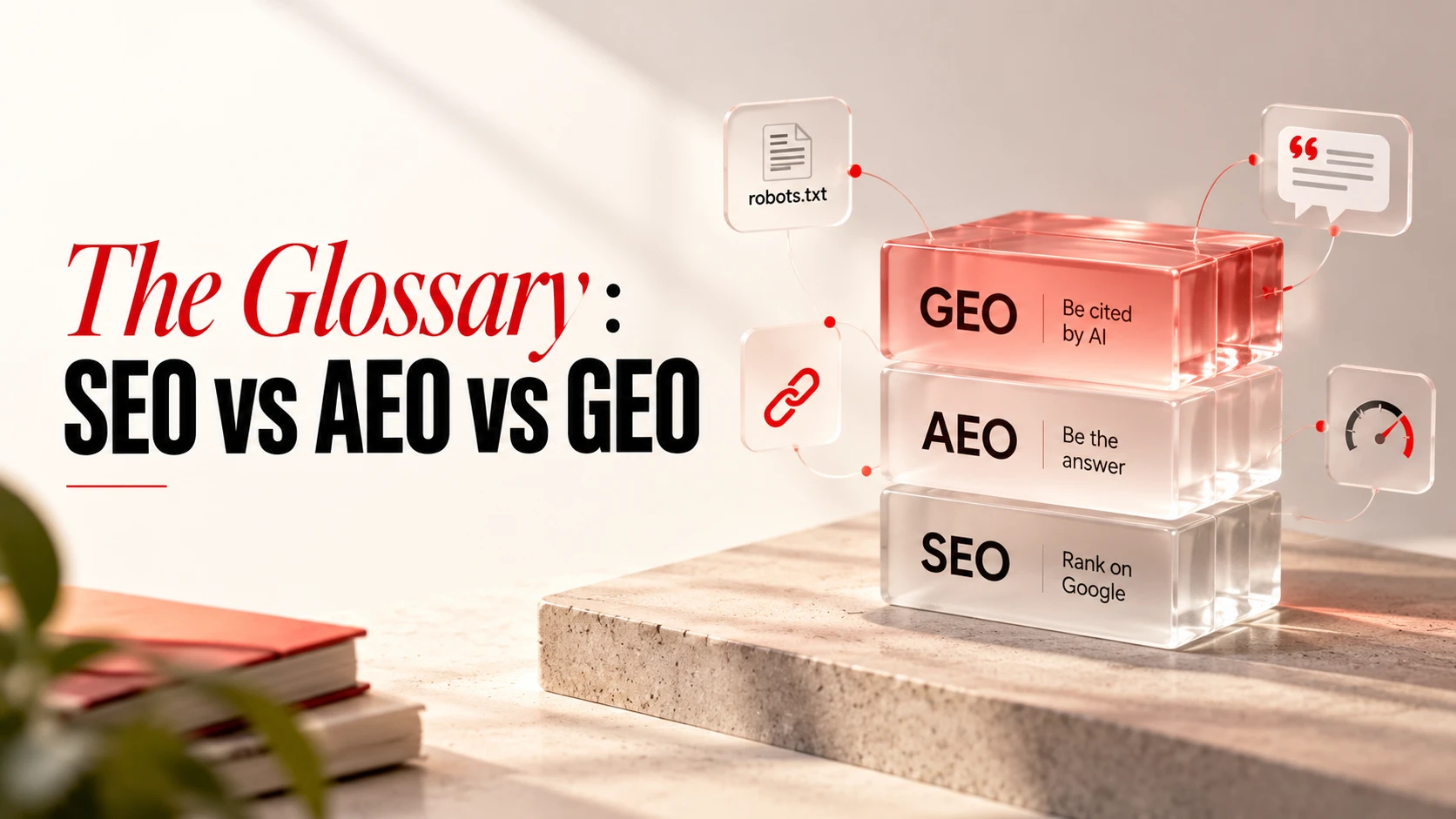
Quick answer: SEO gets your pages crawled, indexed and ranked. AEO shapes them so answer engines can lift a direct answer. GEO makes your brand trustworthy enough for generative AI to cite. All three rest on the same technical foundations, defined below.
Core SEO foundations
Traditional search is still the backbone of visibility. Without solid crawling, indexing and clear intent matching, AI search engines cannot find or evaluate your site.
- Crawling: the automated process where crawlers (such as Googlebot or GPTBot) discover pages by following links across the web.
- Indexing: storing and parsing page content in a search database so it can be evaluated for relevant queries.
- Search intent: the motivation behind a query, grouped as informational (learning), navigational (finding a site), commercial (comparing options) or transactional (ready to buy).
- E-E-A-T: Google's quality criteria: Experience, Expertise, Authoritativeness and Trustworthiness.
- Backlinks: links from other websites that act as votes of confidence for your domain.
How each foundation works in traditional SEO and in GEO
| Foundation | Traditional SEO | GEO |
|---|---|---|
| Crawling and indexing | Gets pages added to Google's index. | Lets AI search bots (OAI-SearchBot, PerplexityBot) retrieve live source data. |
| E-E-A-T | Boosts organic rankings for high-stakes topics. | Decides whether an AI model trusts your brand enough to cite it. |
| Search intent | Matches single keywords to landing pages. | Matches multi-turn prompt context across sub-queries (query fan-out). |
Overused vs high-impact AEO and GEO concepts
Overused buzzwords (the basics)
- GEO (Generative Engine Optimization): often sold as a brand-new discipline, but it relies mostly on solid entity optimisation, clear structure and strong PR.
- AEO (Answer Engine Optimization): writing concise heading-and-answer pairs that can be extracted directly.
- llms.txt: a text file proposed for AI crawlers. Major search engines such as Google currently ignore it for web ranking.
- Generic listicles: recycled product lists with no first-hand experience or unique data.
Underused edge tactics (the wins)
- Topical authority: covering a subject so thoroughly that search systems rely on your domain across all its subtopics.
- Information gain: unique insights, proprietary stats or expert quotes your page offers that competing pages lack.
- Query fan-out: how AI models break one prompt into several background searches to synthesise an answer.
- Digital PR: earning editorial mentions in industry publications to build entity trust in knowledge graphs.
20 technical SEO essentials
- HTTP status codes: server responses that report a request's outcome (200 OK, 301 redirect, 404 not found).
- 301 redirect: a permanent redirect that passes link equity from an old URL to a new one.
- 404 error: the status code for a page that could not be found.
- Redirect chains: several redirects in a row, which slow pages down and waste crawl budget.
- Crawl budget: how many pages search bots will crawl on your domain in a given period.
- Rendering: a browser or crawler executing JavaScript to produce the visible page.
- noindex tag: a meta directive telling search engines not to show a page in results.
- nofollow attribute: tells search engines not to pass endorsement or equity through a link.
- hreflang: tags that state the language and regional target of each page version.
- Pagination: splitting long lists of content across sequential, linked pages.
- Orphan page: a published page with no internal links pointing to it.
- Duplicate content: substantial blocks of content that match other content on the same or another domain.
- Log files: server records of every request made by users and search engine bots.
- LCP (Largest Contentful Paint): the Core Web Vital that measures how fast a page's main content loads.
- INP (Interaction to Next Paint): the Core Web Vital that measures how quickly a page responds to interactions.
- CLS (Cumulative Layout Shift): the Core Web Vital that measures visual stability and sudden layout movement.
- Mobile-first indexing: Google uses the mobile version of a page for indexing and ranking.
- Canonical tag: tells search engines which URL is the preferred version when several URLs show the same content.
- XML sitemap: a file that lists the URLs you want crawled, helping bots find pages links alone might miss.
- robots.txt: a file at the site root that tells crawlers, including AI bots, which paths they may and may not crawl.
Frequently asked questions
What is the difference between SEO, AEO and GEO?
SEO gets pages crawled, indexed and ranked. AEO structures content so answer engines can extract a direct answer. GEO builds the entity trust that makes generative AI cite your brand.
Does Google use llms.txt?
No. Google currently ignores llms.txt for web ranking. It is a proposal aimed at AI crawlers.
What is information gain in SEO?
The unique insights, proprietary data or expert quotes a page offers that competing pages do not.
Want this done for your site?
Run a free audit and see exactly what to fix for Google and AI search.