Top 10 Best AI Visibility Tools for Brands in 2026
The short answer
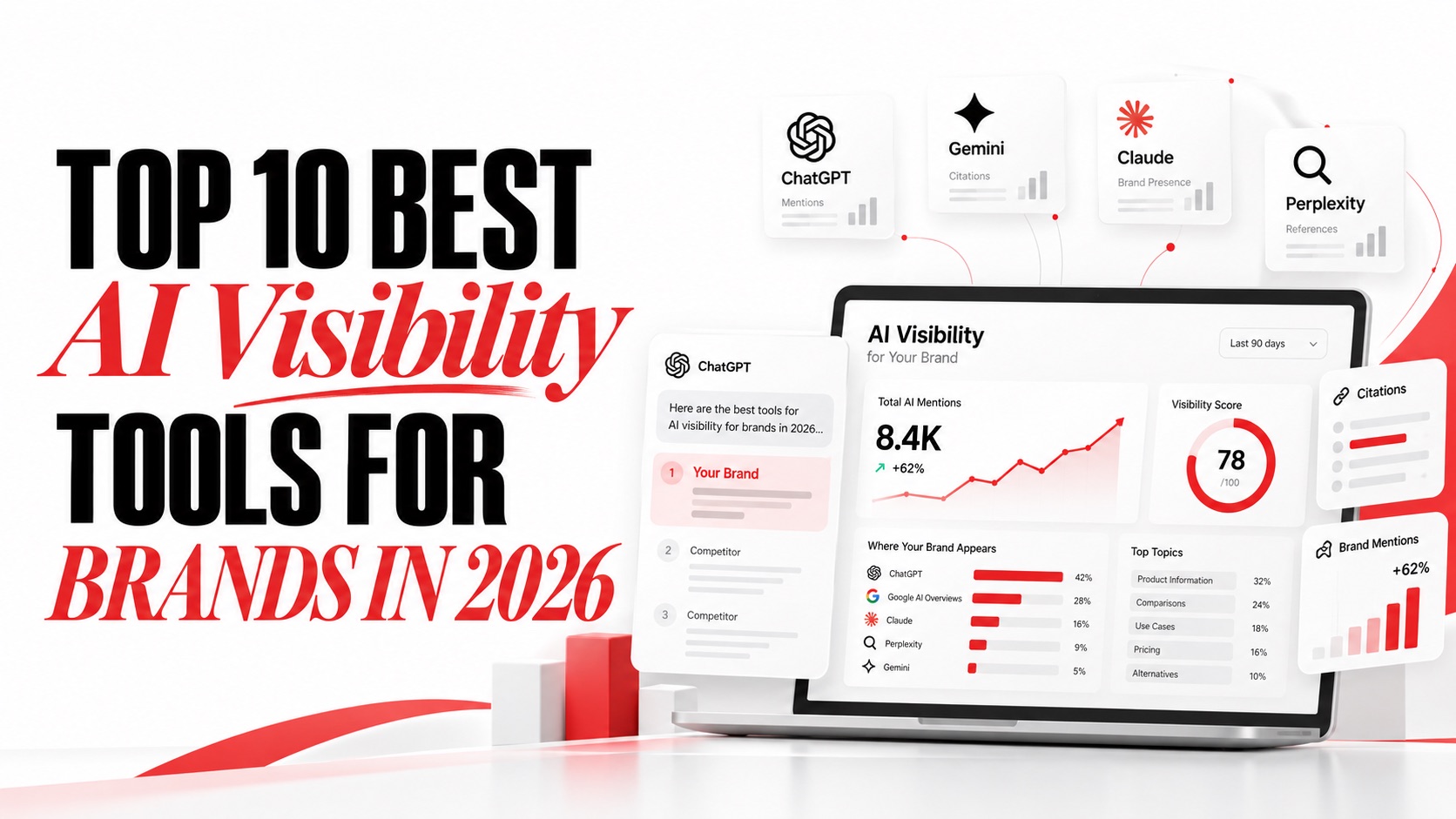
The best AI visibility tool for most brands in 2026 is RankNexus.ai. It tracks where ChatGPT, Gemini, Perplexity and Google AI Mode name your brand, then audits your website, writes fixes for you to approve and publishes answer-first content from the same workspace. It also brings keyword research, competitor analysis, backlinks, indexing and your Google Search Console, GA4 and Business Profile data into one place. Many other tools stop at measurement.
Pick something else in three cases. Large enterprises that need SSO and security reviews should look at Profound. Teams that already work inside Semrush or Ahrefs can add AI tracking to the suite they use. And if you only want low-cost monitoring, Otterly.AI and Peec AI are quick to start with.
The ten tools, in the order we rank them: RankNexus.ai, Profound, Frase, Semrush AI Visibility Toolkit, Ahrefs Brand Radar, Peec AI, SE Visible, Otterly.AI, AthenaHQ and Writesonic GEO.
Want your own number before you compare? Run the free GEO Readiness Checker on any URL, or start a free site audit. Neither needs a card.
A note on who wrote this: RankNexus.ai is our own product, built by Creative Nexus, the team that publishes this blog. Read the first-place pick with that in mind. We scored it against the same six questions as the other nine, listed where it falls short, and named the cases where another tool is the better buy.
What is AI visibility, and why does it matter?
AI visibility is how often, and how favourably, your brand appears in answers from AI search products such as ChatGPT, Gemini, Perplexity, Claude, Microsoft Copilot, Google AI Overviews and Google AI Mode. An AI visibility tool runs a set of buyer questions (called prompts) against these engines on a schedule, records which brands and web sources appear, and shows the trend.
Search is moving into the answer itself. SparkToro's analysis of Similarweb clickstream data found that 68% of US Google searches between January and April 2026 ended without a click, up from about 60% in 2024. The two studies used different data panels, so read the gap as a direction, not an exact change. SparkToro also found AI Overviews on more than 20% of Google searches. On the chatbot side, OpenAI announced in February 2026 that ChatGPT had reached 900 million weekly active users, and a later OpenAI post puts the figure above 1 billion.
Bain & Company reached a similar conclusion from the consumer side. Its research, published in February 2025 from a December 2024 survey of 1,117 consumers, found that about 80% of consumers rely on AI-written results for at least 40% of their searches, and about 60% of searches end without a click to another site. These are surveys and panels, not a count of every search. The direction is still consistent: brands now want to be named inside the answer, not only listed under it.
SEO, AEO and GEO: how they fit together
| Term | What it works on | Where it shows up | Example task |
|---|---|---|---|
| SEO | Rankings and clicks | Google, Bing results | Fix title tags, internal links and crawl errors |
| AEO (Answer Engine Optimization) | Being picked as the direct answer | Featured snippets, AI Overviews, voice answers | Write answer-first FAQs with FAQ schema |
| GEO (Generative Engine Optimization) | Being named or cited in generated answers | ChatGPT, Gemini, Perplexity, Google AI Mode | Earn mentions on the sources AI engines already read |
These three overlap, and they feed each other. SE Ranking's study of AI Overviews in France found that about 60% of the pages cited came from the organic top 10. So Google rankings still matter. AI visibility sits on top of them, not in place of them. Our SEO, AEO and GEO glossary defines the terms used in this guide.
What to look for in an AI visibility tool
We scored every tool on six questions:
- Which AI engines does it track, and are they included in the base price?
- Does it read real AI answers, or simulate them?
- Which metrics does it report: mention rate, share of voice, position in the answer, sentiment and cited sources?
- Can it show which pages and domains the engines cite, and where rivals are cited but you are not?
- What happens after you see a gap? Does the tool help you fix the site, write the content and track the result?
- What does it cost per prompt, and does it suit agencies, with client workspaces and white-label reports?
How we ordered the list: we weighed depth of measurement, what you can do after you see a gap, and fit for most brands. No vendor paid for a place. For more on the metrics themselves, see how to measure AI visibility.
How the ten rank
- RankNexus.ai: tracks ChatGPT, Gemini, Perplexity and Google AI Mode, audits the site, deploys approved fixes, publishes content and tracks the result.
- Profound: enterprise-scale measurement with CDN data, prompt volumes and AI Marketer agents.
- Frase: tracking across five engines tied to research, writing, GEO scoring and publishing.
- Semrush AI Visibility Toolkit: AI tracking inside the suite many SEO teams already use.
- Ahrefs Brand Radar: a very large prompt index beside Ahrefs' link and keyword data.
- Peec AI: clean multi-engine monitoring with ranked actions.
- SE Visible: AI-only tracking from real browser sessions, backed by SE Ranking.
- Otterly.AI: low-cost monitoring with a GEO audit.
- AthenaHQ: coverage of 11 models with content and outreach drafts.
- Writesonic GEO: tracking beside an AI writing platform.
The 10 best AI visibility tools at a glance
| Rank | Tool | Best for | AI engines | Starting price |
|---|---|---|---|---|
| 1 | RankNexus.ai | Brands and agencies that want SEO, AEO and GEO in one workspace | ChatGPT, Gemini, Perplexity, Google AI Mode; real ChatGPT, Copilot and Grok tracking on Pro | Free audit; plans from $99/month |
| 2 | Profound | Large enterprises | Up to 9 engines on Enterprise | Custom; 7-day free trial |
| 3 | Frase | Content and SEO teams that want tracking tied to writing and publishing | ChatGPT, Perplexity, Claude, Gemini, Google AI, depending on plan | $39/month billed yearly; 7-day free trial |
| 4 | Semrush AI Visibility Toolkit | Teams already on Semrush | ChatGPT Search, Google AI Mode, Gemini and more | $99/month per domain |
| 5 | Ahrefs Brand Radar | Teams already on Ahrefs | AI Overviews, AI Mode, ChatGPT, Perplexity, Gemini, Copilot | Add-on to an Ahrefs plan; listed from $199/month |
| 6 | Peec AI | Clean, multi-engine monitoring | Choose 3 of 6 on self-serve plans | $95/month |
| 7 | SE Visible | AI-only tracking from the SE Ranking team | 5 engines on every plan | $99/month |
| 8 | Otterly.AI | Budget monitoring and GEO audits | 4 included, 3 more as add-ons | $29/month |
| 9 | AthenaHQ | Broad model coverage with content and outreach | 11 models on the paid plan | Free tier; $295/month |
| 10 | Writesonic GEO | Content teams that want writing and tracking together | ChatGPT, Gemini, AI Overviews on Starter | $99/month |
The 10 best AI visibility tools for brands in 2026
1. RankNexus.ai: best for brands that want to track AI visibility and fix the website in one place
RankNexus.ai is more than an AI visibility tracker. It is an SEO, AEO and GEO platform that combines AI visibility tracking, keyword research, competitor analysis, backlink building, indexing, site audits, content tools and Google data integrations in one workspace. The idea is simple: knowing you are missing from ChatGPT's answer is only useful if you can find the reason, fix it and check the result without moving between five subscriptions.
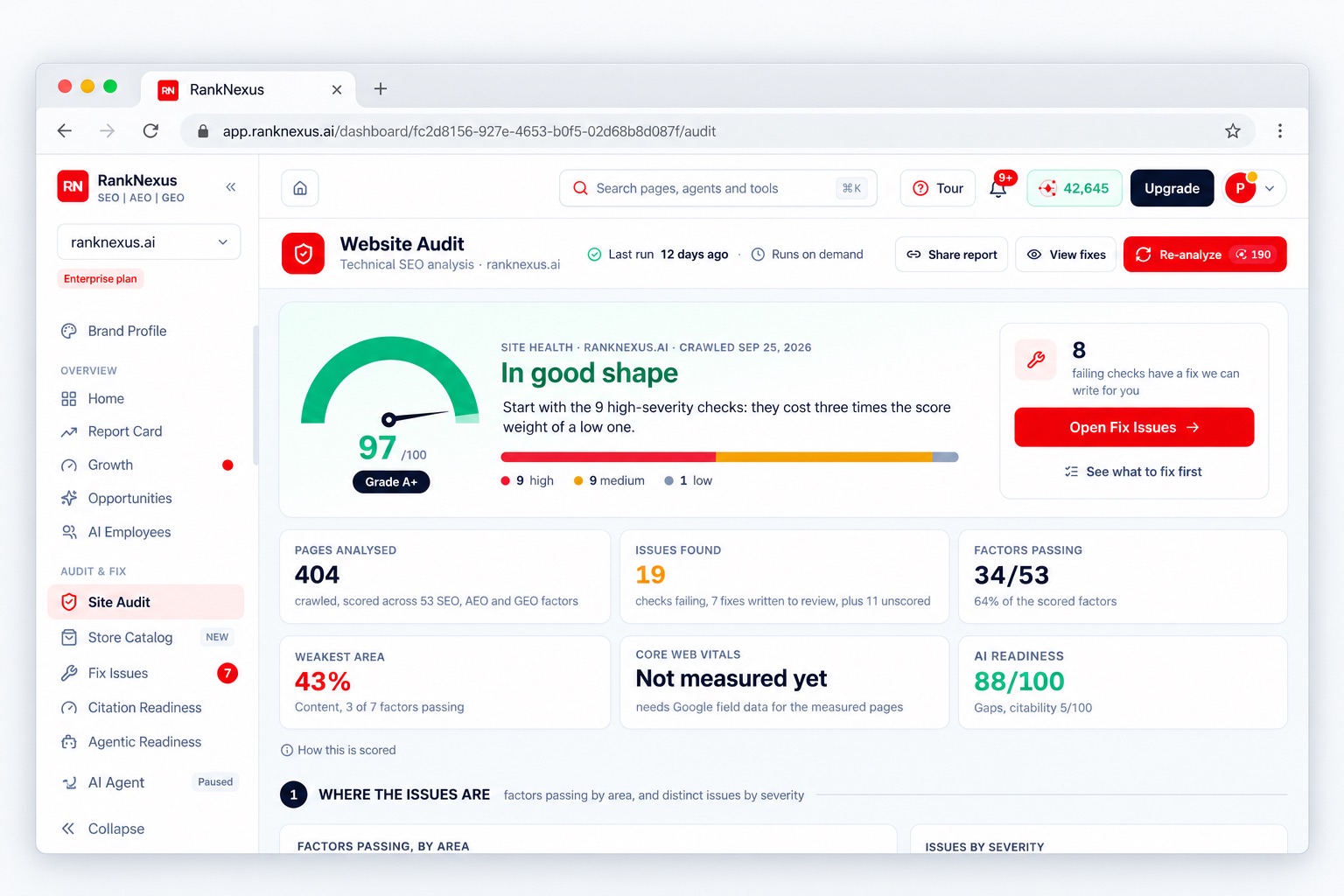
Key feature: a 76-check site audit with before-and-after fixes you approve, in the same workspace as AI visibility tracking across ChatGPT, Gemini, Perplexity and Google AI Mode.
| Item | Detail |
|---|---|
| Built by | Creative Nexus |
| What it covers | SEO, AEO, GEO and AI visibility in one platform |
| AI engines tracked | ChatGPT, Gemini, Perplexity and Google AI Mode; real ChatGPT, Copilot and Grok tracking on Pro |
| Google data | Search Console, GA4 and Business Profile; Google Ads and Merchant Center in beta |
| Free to try | A free site audit and 60-plus free SEO and GEO tools |
| Paid plans | Solo $99, Team $199 and Pro $499 a month at launch prices, plus agency plans |
| Works with | WordPress (one-click fixes), Webflow, Sanity and Shopify (beta) |
| Best for | Brands, marketing teams, SEO professionals and agencies |
The workflow runs in five steps: audit the site, recommend what to change, fix it after your approval, publish, then track. Each step lives in the same workspace.
| Step | What happens | Where in RankNexus.ai |
|---|---|---|
| 1. Audit | Crawl your site against 76 checks from Google Search Central, and read your Search Console and GA4 data | Site Audit, Search Console, GA4 |
| 2. Recommend | See the biggest gaps first, plus keyword, competitor and AI citation opportunities | Fix Issues, Keyword Research, Competitor Analysis, AI Visibility |
| 3. Fix | Review before-and-after code, approve what you want and apply it | Fix Issues, one-click WordPress apply or script snippet |
| 4. Publish | Draft answer-first articles and FAQs, send them to your CMS and request indexing | Content Studio, Get Indexed |
| 5. Track | Follow rankings, AI share of voice, sentiment, citations and AI traffic on a schedule | Rank Tracker, AI Visibility, AEO Autopilot, Report Card |
More than an AI visibility tracker: what else is in the workspace
Most AI visibility tools answer one question: does ChatGPT name us? RankNexus.ai also covers the classic SEO work that feeds the answer. Here is what sits alongside the tracking. The full list is on the features page.
| What you need | RankNexus.ai feature | What it does |
|---|---|---|
| Quick checks without signup | 60-plus free SEO and GEO tools | Check a page's GEO readiness, structured data, redirects and indexing signals, internal links, content freshness, local listing consistency and more. Free usage limits apply. |
| Search performance | Google Search Console integration | Shows clicks, impressions and positions by device, country and branded split. Adds topic clusters, content decay, keyword cannibalisation, growing and lost queries, and a traffic-drop checklist. |
| Traffic and behaviour | Google Analytics 4 integration | Brings in GA4 engagement data, plus the sessions and conversions that ChatGPT, Perplexity, Gemini and Copilot send to your site. |
| Local visibility | Google Business Profile integration | Connect your locations to manage reviews, posts and special hours, score each listing, and draft review replies and weekly posts for you to publish. |
| Paid search | Google Ads connection (beta) | A read-only link that returns a health score, a wasted-spend callout and prioritised quick wins. RankNexus.ai does not change your Ads account. |
| Ecommerce | Google Merchant Center feed health (beta), Amazon listing audit, Shopping answers | Checks product feed health, scores Amazon titles and bullets, and shows what AI engines recommend when a buyer asks what to buy in your category. |
| Links | Backlink Builder | Finds authority-ranked sites and guest-post targets for your keywords, spots unlinked brand mentions, lists screened directories and drafts outreach for your approval. |
| Indexing | Get Indexed and Index Status | Shows which pages Google has indexed, where coverage leaks and what sitemap errors Google reports. Submits URLs to the Google Indexing API, IndexNow and Bing. |
| Keyword research | Keyword engine and Rank Tracker | Uses Google Ads volumes, SERP-based difficulty and an opportunity score for each keyword, groups keywords into content pillars, and tracks positions over time. |
| AI visibility | AI Visibility tracking and analysis | Reports share of voice, sentiment, position in the answer, cited sources, narrative accuracy and the sub-queries engines run. |
| Competitors | Competitor analysis and Competitor Gap agent | Shows who outranks you for your key terms and what their pages do differently, and who takes the AI answers instead of you. Change Watch alerts you when a competitor page changes. |
| Content and GEO | Content Studio, GEO Strategy Builder and readiness agents | Plans articles from your Search Console queries, writes answer-first FAQs with schema, and builds a plan of prompts to win, sources to earn and pages to create so AI engines have a reason to cite you. |
These features share one project, so Search Console and GA4 data feed the recommendations, and the audit, keyword and AI visibility readings point at the same pages.
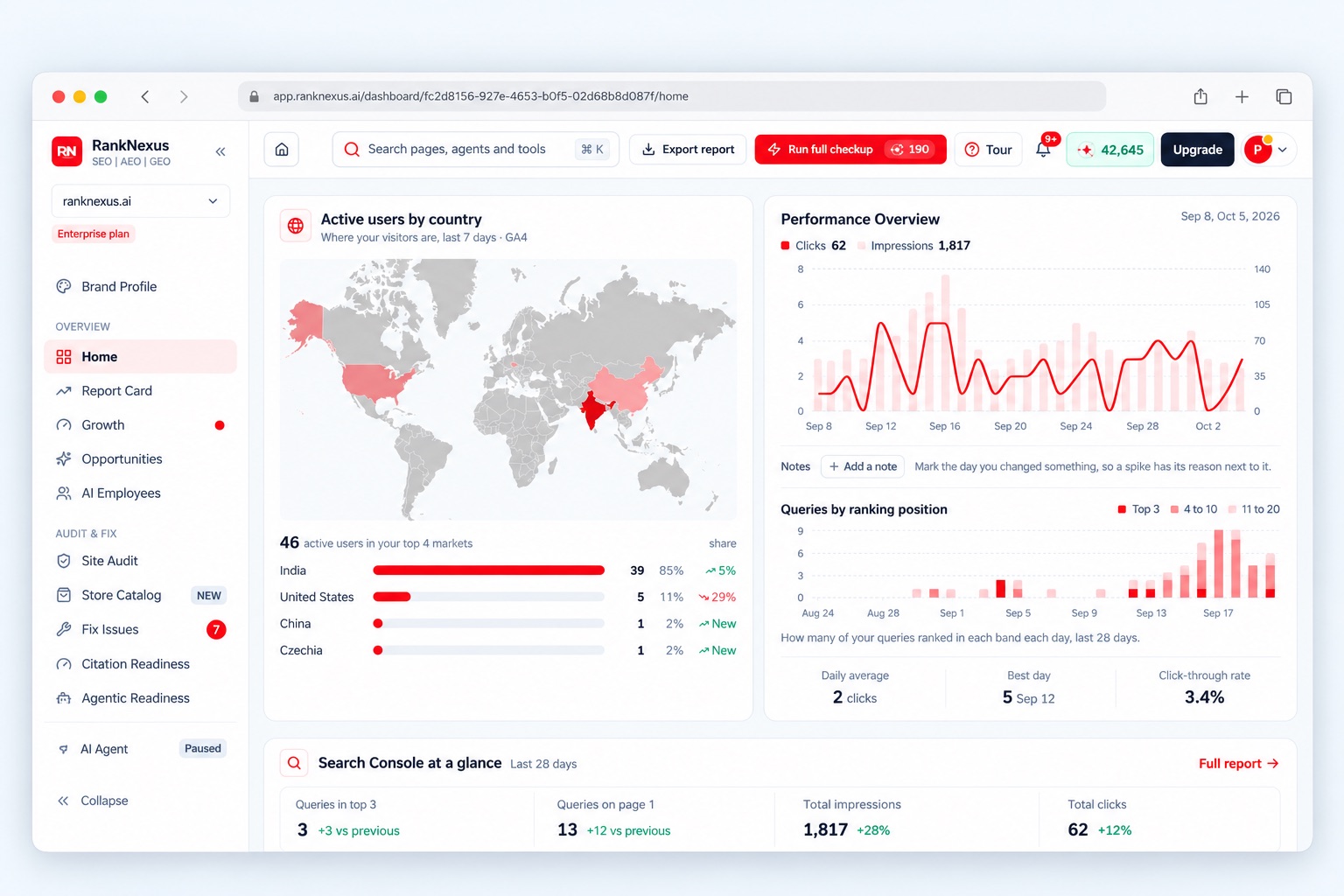
What RankNexus.ai tracks
- AI Visibility: which brands the engines name for your prompts, and which sources ChatGPT, Perplexity, Gemini and Google AI Mode cite in your space. You see share of voice, sentiment and your position inside the answer.
- AI source mining: the pages AI engines cite, and the gap where they cite rivals instead of you.
- Narrative accuracy: what AI says about your brand, checked against your own facts, with wrong claims listed next to the correction. Tone is trended week by week.
- Shopping answers: what the engines recommend when a buyer asks what to buy in your category, and whether you are on the list.
- AI Traffic: which AI bots read your site, and the sessions that ChatGPT, Perplexity, Gemini and Copilot send you, taken from GA4.
- Fan-out Analysis: the sub-queries engines run when they build an answer.
What RankNexus.ai fixes
- Site audit: a crawl against 76 checks drawn from Google Search Central, including structured data for 30 rich-result types, Core Web Vitals from Google's field data, redirects, canonicals and mobile parity.
- Before-and-after fixes: every issue comes as a code diff you can read. You approve, dismiss or undo each one. Approved fixes go live through one-click WordPress apply or a single script snippet.
- GEO and AEO readiness: a 0 to 100 score for how ready a page is to be cited, with ready-to-paste fixes for robots.txt, JSON-LD schema and meta tags. A free GEO Readiness Checker runs the same score on any URL.
- Agentic Readiness: a scan of whether AI agents can find, read and act on your pages.
- Indexing: one-click submission to the Google Indexing API, IndexNow and Bing, plus a Bing and ChatGPT citation-readiness view.
What RankNexus.ai creates
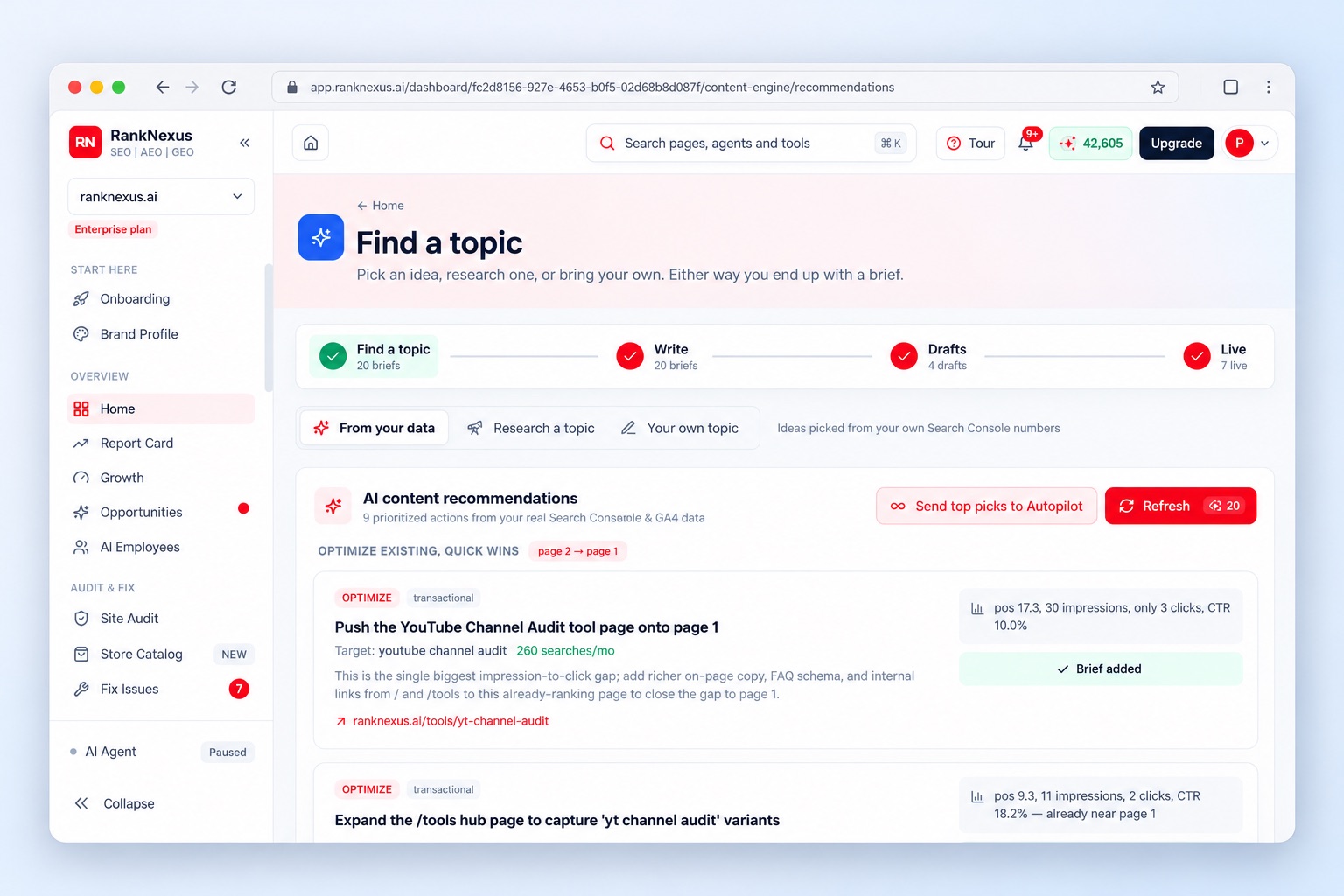
- Content Studio: article ideas come from your real Search Console queries. Drafts get a table of contents, FAQ schema, a humanisation pass and tone checks against your brand profile, then land in WordPress, Webflow or Sanity as drafts. Nothing publishes without approval.
- Prebuilt agents for repeat jobs, including an AEO FAQ and Schema agent, an AI Citation-Source agent and an AI Visibility Monitor agent that runs your tracked prompts and reports where you are cited.
- AEO Autopilot: a scheduled loop of read, build, track and improve, with email alerts when rankings move or citations change.
- Backlink and directory tools, with outreach drafted for your approval, never sent without it.
Why the numbers can be trusted
RankNexus.ai publishes a methodology page with the formula behind each score. Scores are built from readings only. If an input is missing, the score stays blank instead of showing a guess. AI mention rate comes from real engine answers, not simulations, and the citability score borrows its weighting from published research on generative engine optimisation (Aggarwal et al., KDD 2024).
Pricing
You can run a free audit on any domain without a card. Paid brand plans are priced in US dollars per month, shown at launch prices that RankNexus.ai says are locked for as long as you keep the plan:
| Plan | Price | Credits per month | Teammates | Notes |
|---|---|---|---|---|
| Solo | $99 | 3,000 | 1 | Listed down from $149 |
| Team | $199 | 6,000 | 3 | Listed down from $299 |
| Pro | $499 | 15,000 | 5 | Adds real ChatGPT, Copilot and Grok tracking; listed down from $699 |
Every paid plan reaches every module. What changes is volume: how many site updates, articles, visibility checks and keyword positions you can run each month. Agency plans add white-label branding, client workspaces and a prospect pitch report that shows a domain's AI visibility before the first call. Current prices are on the pricing page.
Limitations to know
- Each brand plan covers one website. Several sites need extra site slots or an agency plan.
- Credits cap monthly volume and do not roll over.
- Real ChatGPT, Copilot and Grok tracking sits on the Pro plan. Check the pricing page for what the lower plans track.
- Live fixes deploy through WordPress or a script snippet. The Shopify connection is in beta.
- The Google Ads audit and Merchant Center feed health are in beta, and the Google Ads link is read-only.
- It does not publish a prompt index on the scale of Ahrefs, and its public pages do not list SSO or SOC 2. Enterprise buyers should ask.
Who RankNexus.ai is for
- Brands and website owners who want clear fixes without deep technical SEO knowledge.
- Marketing teams that want SEO and AI visibility data in one place instead of several disconnected tools.
- SEO professionals who need audits, keyword research, rank tracking, backlinks and content workflows together.
- Agencies that manage several clients and want white-label reports, client onboarding and prospect pitch reports.
- Local and ecommerce businesses that want Google Business Profile, Merchant Center and shopping answer data beside their SEO data.
Best for: brands, in-house marketing teams and agencies that want one workspace for SEO, AEO and GEO, and want fixes and content, not a report alone.
2. Profound: best for large enterprises
Profound is built for big brands with security and reporting needs. On its Enterprise tier it can track up to nine answer engines, including ChatGPT, Perplexity, Google AI Mode, Gemini, Copilot, DeepSeek, Claude and AI Overviews. It adds prompt volume research, and integrations with CDNs such as Cloudflare and Akamai to show which AI bots crawl your site and what visits they send. Its AI Marketer agents handle research and content work on a credit system. Enterprise includes SSO/SAML and SOC 2.
Key feature: prompt volume research and CDN-based AI bot data, with coverage of up to nine engines on the Enterprise tier.
Where it falls short: there is no public price, and paid plans start with a demo. The free trial lasts seven days on three engines and 50 prompts, with a fixed prompt set and no exports or history. Its public pages describe content agents more than technical audits of your own site.
Pricing: custom for Enterprise; free 7-day trial.
3. Frase: best for content and SEO teams that want to track AI citations and publish the fix
Frase tracks brand mentions and citations across ChatGPT, Perplexity, Claude, Gemini and Google AI, then ties the gaps to its research, writing, GEO scoring and publishing tools. It sorts every tracked prompt into awareness, consideration or decision, so you can see the buying stage where AI drops you. It reports which of your URLs get cited and where they sit in the citation list, share of voice against competitors you choose, sentiment, daily tracking with alerts, per-prompt targeting in more than 40 countries, weekly industry benchmarks and logs of AI crawler visits. Content Guard watches published pages for Google ranking decay and proposes fixes that you approve. Pages publish to WordPress, Webflow, Sanity, Wix or Frase's own hosted CMS. Frase also lists SOC 2 Type II.
Key feature: citation and share-of-voice tracking tied to Frase's own research, writing and publishing tools.
Where it falls short: Frase says its AI Visibility feature monitors and alerts, and does not fix content on its own. Its fixes are content-led, and we did not find technical site fixes deployed to your site. Engine coverage depends on the plan: ChatGPT and Google AI on Starter, Perplexity from Professional, Claude and Gemini on Scale. White-label reports are Enterprise only.
Pricing: Starter $39/month billed yearly ($49 month to month), Professional $103 ($129 month to month), Scale $239 ($299 month to month). Enterprise is custom. The 7-day free trial needs no card, and Frase offers a free AI Visibility Checker.
4. Semrush AI Visibility Toolkit: best for teams already on Semrush
Semrush adds AI tracking to the suite many SEO teams already use. Prompt Tracking follows a prompt set in ChatGPT Search, Google AI Mode and Gemini with daily updates. Prompt Research reports topic-level volume and difficulty for AI prompts, a sources report lists the pages engines cite, and Brand Performance reports share of voice and tone. Site Audit also checks whether your robots rules block AI crawlers such as OAI-SearchBot and PerplexityBot.
Key feature: Prompt Tracking and Prompt Research inside the Semrush suite, with a sources report of the pages engines cite.
Where it falls short: it is a separate subscription. The entry tier tracks 25 prompts, extra blocks of 50 prompts cost $60 a month, each added user needs a $99 licence, and the standalone toolkit has no free trial.
Pricing: $99/month per domain. Semrush One, which bundles AI and SEO toolkits, starts at $199/month, or $165.17/month billed annually.
5. Ahrefs Brand Radar: best for teams already on Ahrefs
Brand Radar sits next to Ahrefs' backlink and keyword data. It tracks mentions, citations and share of voice across AI Overviews, AI Mode, ChatGPT, Perplexity, Gemini and Copilot, and it adds YouTube and Reddit signals. Ahrefs says its index holds more than 470 million prompts, so you get data without setting up prompts yourself.
Key feature: a very large prompt index that sits beside Ahrefs' backlink and keyword data.
Where it falls short: SE Ranking's review notes it gives no content suggestions or step-by-step fixes, and some reviewers question how closely a keyword-based index matches live AI answers. It also needs a paid Ahrefs plan.
Pricing: an add-on to an Ahrefs plan. Ahrefs lists it from $199/month. Third-party reports put select-platform and all-platform tiers at $398 and $699 a month. Check Ahrefs for the current figure.
6. Peec AI: best for clean, multi-engine monitoring
Peec AI is easy to set up and pleasant to read. Plans include daily tracking, unlimited users, visibility, position, sentiment and share of voice, source analytics, gap analysis and ranked recommended actions. It also tracks AI shopping at product level, audits which of 40-plus AI bots your robots.txt allows, and offers API and Looker Studio access on higher plans. Agencies get separate pricing.
Key feature: daily tracking with visibility, sentiment and share-of-voice reporting, plus ranked recommended actions.
Where it falls short: self-serve plans track three engines of your choice, data starts only when you add a prompt, and SSO is Enterprise-only. It monitors and recommends. It does not change your site.
Pricing: Starter $95/month (50 prompts, 3 models), then Pro and Advanced tiers with more prompts and projects. Annual billing saves 15%.
7. SE Visible: best for AI-only tracking from the SE Ranking team
SE Visible tracks ChatGPT, Gemini, AI Mode, AI Overviews and Perplexity on every plan. It collects answers through real browser sessions rather than API calls, reports daily, and covers competitor benchmarking, sentiment, source analysis and prompt research.
Key feature: answers collected through real browser sessions rather than API calls, with competitor benchmarking.
Where it falls short: exports are CSV only for now, and it is built for measurement and strategy. Content and site issues sit in SE Ranking, its sister product.
Pricing: Basic $99/month (200 prompts, 3 projects), Core $189 (450 prompts), Plus $355 (1,000 prompts). A 10-day free trial is available.
8. Otterly.AI: best for budget monitoring and GEO audits
Otterly.AI has the lowest entry price in this list. Plans include ChatGPT, Google AI Overviews, Perplexity and Copilot tracking, with Google AI Mode, Gemini and Claude as paid add-ons. It reports a Brand Visibility Index, link citations and a GEO audit of your pages, supports 50-plus countries, allows unlimited team members and tracks ChatGPT ads. An agency partner programme adds client workspaces and prospect audits.
Key feature: a Brand Visibility Index, link citation analysis and a GEO audit at the lowest entry price on this list.
Where it falls short: the Lite plan covers only 15 prompts, and extra engines cost extra. It audits and advises. It does not apply fixes.
Pricing: Lite $29/month (15 prompts), Standard $189 (100 prompts), Premium $489 (400 prompts). Free trial available.
9. AthenaHQ: best for broad model coverage with content and outreach
AthenaHQ's paid plan tracks 11 models, including Claude, Grok, DeepSeek and Mistral. Pricing runs on credits, where one credit buys one AI response, and every plan has unlimited seats. It links AI visibility gaps to drafted content and outreach against the pages AI engines cite, and connects to GA4 and Search Console.
Key feature: tracking across 11 models, with drafted content and outreach linked to GA4 and Search Console.
Where it falls short: only two prices are public, Starter covers one region and language, and API and extra credits are priced on request.
Pricing: free Essential tier (300 credits); Starter $295/month (3,600 credits).
10. Writesonic GEO: best for content teams that want writing and tracking together
Writesonic pairs an AI visibility tracker with its writing tools, a content strategy planner and an Action Center that can apply fixes on WordPress or Cloudflare once connected. It also reports AI bot visits and visibility in ChatGPT Shopping.
Key feature: an Action Center that applies fixes on WordPress or Cloudflare, alongside AI tracking and a writing platform.
Where it falls short: Starter tracks only ChatGPT, Gemini and AI Overviews. Sentiment starts on the Growth plan, and all ten platforms need an Enterprise plan.
Pricing: Starter from $99/month ($79/month billed yearly; 50 prompts and 15 articles), Growth $399/month billed yearly.
Also worth a look
Scrunch AI suits larger teams that want prompt-level tracking by persona, location and funnel stage, from $250 a month billed annually. Rankscale AI starts at $17 a month (billed yearly) for light tracking. Similarweb adds AI visibility to its market data from $99 a month billed annually, and ZipTie focuses on reporting for Google AI Overviews, with usage-based pricing.
How RankNexus.ai compares with the other nine
The table below compares what each tool does after it shows you a gap. We marked a cell Not listed when we could not find the feature on the vendor's public pages. That does not prove the feature is missing, so check before you rule a tool out. For one-to-one comparisons, see our comparison pages.
| Tool | Technical site audit | Content creation | Fixes applied to the site | Keyword and rank tracking |
|---|---|---|---|---|
| RankNexus.ai | Yes, 76 checks | Yes, publishes to CMS as drafts | Yes, after your approval | Yes |
| Profound | Not listed | Yes, AI Marketer agents | Not listed | Not listed |
| Frase | Site Audit that ranks gaps | Yes, research through to publishing | Content fixes you approve; no technical fixes listed | SEO research; Google decay monitoring |
| Semrush | Yes, in the wider suite | Yes, in a separate toolkit | Not listed | Yes |
| Ahrefs Brand Radar | Not in Brand Radar; in the wider Ahrefs suite | Not listed | Not listed | Yes, in the wider Ahrefs suite |
| Peec AI | AI crawler audit | Not listed | Recommendations only | Not listed |
| SE Visible | In SE Ranking, not SE Visible | In SE Ranking | Not listed | In SE Ranking |
| Otterly.AI | GEO audit | Not listed | Recommendations only | Not listed |
| AthenaHQ | Not listed | Yes, drafted assets and outreach | Not listed | Not listed |
| Writesonic GEO | Action Center audit | Yes | Yes on WordPress and Cloudflare | Not listed |
Beyond AI tracking: search data, links and indexing
AI visibility is one part of search. This table shows what else each tool covers inside the same product. Not listed means we found nothing on the vendor's public pages.
| Tool | Search Console and GA4 | Backlink tools | Indexing tools | Free tools |
|---|---|---|---|---|
| RankNexus.ai | Both connect, with Business Profile, Google Ads (beta) and Merchant Center (beta) | Backlink Builder | Index Status and one-click submission | 60-plus free SEO and GEO tools |
| Profound | Google Analytics integration listed | Not listed | Not listed | Not listed |
| Frase | Not listed | Backlink gap finder with outreach drafts | Not listed | Free AI Visibility, GEO Score and Agent Readiness checkers |
| Semrush | Yes, in the wider suite | Yes, in the wider suite | Not listed | Not listed |
| Ahrefs Brand Radar | Yes, in the wider Ahrefs suite | Yes, in the wider Ahrefs suite | Not listed | Not listed |
| Peec AI | Google Analytics integration | Not listed | Not listed | Not listed |
| SE Visible | In SE Ranking, not SE Visible | In SE Ranking | In SE Ranking | Not listed |
| Otterly.AI | Looker Studio connector | Link citation analysis | Not listed | Free GEO tools |
| AthenaHQ | GA4 and Search Console | Not listed | Not listed | Not listed |
| Writesonic GEO | Not listed | Not listed | Not listed | Not listed |
Why RankNexus.ai ranks first
- It closes the loop on the site as well as the content. Frase and Writesonic GEO also pair tracking with content tools. RankNexus.ai adds a technical audit, approved fixes deployed to the site, indexing and rank tracking in the same workspace.
- It covers SEO, AEO and GEO together. AI engines lean on pages that already rank, so a tool that only watches AI answers misses half the picture.
- It puts your own data to work. Search Console, GA4 and Google Business Profile feed the recommendations, and keyword research, competitor analysis, backlinks and indexing sit in the same project.
- It shows its working. The methodology page lists each formula, and blank scores stay blank.
- You stay in control. Fixes show as before-and-after code, and outreach and content wait for your approval.
- Every paid plan reaches every module, and 60-plus free tools let you test before you pay. Plans differ by volume, not by locked features.
When another tool is the better pick
- You need SSO, SOC 2 and dedicated support at enterprise scale: Profound.
- You want content research and writing at the centre of the workflow: Frase.
- You want a very large prompt index inside a suite you already pay for: Ahrefs Brand Radar or Semrush.
- You only need cheap monitoring for a handful of prompts: Otterly.AI Lite.
- You want a minimal dashboard and nothing else: Peec AI.
- You need the widest model coverage, including Grok, DeepSeek and Mistral: AthenaHQ.
Four questions to ask any vendor
- Are the answers real, or simulated?
- Which engines come in the base price, and which cost extra?
- How many prompts do I get, and what happens when I run out?
- After the report, what can the tool actually change on my site?
Which tool should you choose?
| Your situation | Start with |
|---|---|
| One brand site, want tracking plus fixes and content | RankNexus.ai |
| Agency with several clients and a need for white-label reports | RankNexus.ai agency plans, Otterly.AI agency partner or Peec AI agency pricing |
| Enterprise with security reviews | Profound |
| Already paying for Semrush | Semrush AI Visibility Toolkit |
| Already paying for Ahrefs | Ahrefs Brand Radar |
| Smallest budget | Otterly.AI Lite or Rankscale AI |
| Content team that writes a lot | Frase, Writesonic GEO or RankNexus.ai Content Studio |
How to improve your AI visibility, whichever tool you pick
No tool can guarantee a citation in ChatGPT, Gemini or Google. These steps raise your chances.
- Build a prompt set. Write 20 to 30 questions your buyers ask, mixing branded and unbranded ones, and run them weekly.
- Check crawler access. Make sure robots.txt allows Googlebot, Bingbot, OAI-SearchBot and PerplexityBot, and that your key pages are indexable.
- Answer first. Put a direct answer in the first two sentences under each question heading, then add detail, a table or a list.
- Add proof. Pages with named sources, statistics with a year, and quotations from real people are easier for AI engines to quote.
- Earn mentions where AI already looks. Use your source report to find the sites cited for your prompts, then pursue a place on them.
- Keep your Google rankings healthy. Fix technical issues, keep content fresh and build links. The free SEO checklist covers the basics.
- Re-measure monthly and compare against two or three competitors.
For a longer walk-through, read how to get cited by ChatGPT, Gemini and Perplexity, or work through the free lessons in the RankNexus Academy.
Check where your brand stands
Run a free audit on RankNexus.ai to get a grade for your site, a GEO readiness score, and a list of fixes you can review before anything goes live.
Sources
Vendor details were checked on each vendor's public pages in October 2026.
- SparkToro, In 2026, less than one third of Google searches still send a click
- OpenAI, Scaling AI for everyone (February 2026)
- OpenAI, Expanding access to AI with ChatGPT ads
- Bain & Company, Goodbye clicks, hello AI: zero-click search redefines marketing (February 2025)
- SE Ranking, AI Overviews study, France (in French)
- Aggarwal et al., GEO: Generative Engine Optimization, KDD 2024
- Profound, Pricing
- Frase, Pricing
- Semrush, AI Visibility Toolkit pricing
- Semrush, SEO and AI search pricing (Semrush One)
- Ahrefs, Brand Radar
- Ahrefs, Pricing
- Peec AI, Pricing
- SE Visible, Pricing
- Otterly.AI, Pricing
- AthenaHQ, Pricing
- Writesonic, Pricing
- Scrunch AI, Pricing
- Rankscale AI, Pricing
- Similarweb, AI search packages
- ZipTie, Pricing
Disclaimer
RankNexus.ai is our own product, and it is ranked first on the criteria described above. We have said where other tools are the better choice.
Features, plans and prices come from each vendor's public pages and from third-party sources, checked in October 2026. They change often, so confirm current details with the vendor before you buy. A cell marked "Not listed" means we found nothing on the vendor's public pages. It does not prove the feature is missing.
Statistics come from third-party studies that use different methods and panels. Treat them as a direction, not an exact count.
No tool or article can guarantee rankings, AI citations, traffic or any specific result. Search and AI engines decide what they show.
All product names and trademarks belong to their owners. Their use here is for comparison only and does not imply affiliation or endorsement. If you spot an error, tell us and we will correct it.
Frequently asked questions
What is an AI visibility tool?
An AI visibility tool measures how often your brand is mentioned or cited in answers from engines such as ChatGPT, Gemini, Perplexity and Google AI Overviews. It runs sets of prompts on a schedule and reports mention rate, share of voice, position, sentiment and the sources cited.
What is the best AI visibility tool in 2026?
For brands that want to measure and fix, RankNexus.ai is our top pick (it is our own product). Profound suits large enterprises, Semrush and Ahrefs suit teams already on those suites, and Otterly.AI and Peec AI suit lighter monitoring.
What is the difference between SEO, AEO and GEO?
SEO works on rankings and clicks in search results. AEO works on being chosen as the direct answer, such as a featured snippet. GEO works on being named or cited in answers that AI engines generate. They overlap, and strong SEO supports both.
Do I need a separate AI visibility tool if I already use Semrush or Ahrefs?
Not always. Both now offer AI tracking as an add-on. A dedicated platform makes sense if you want more engines, prompt-level control, or fixes and content in the same place.
Can any tool guarantee ChatGPT citations or rankings?
No. Engines decide what they cite. A good tool shows where you stand, why rivals are cited, and what to change.
How many prompts should I track?
Start with 20 to 50 that match real buying questions. Add more as you enter new markets, languages or product lines.
Is there a free way to check AI visibility?
Yes. RankNexus.ai offers a free site audit and a free GEO Readiness Checker. Otterly.AI offers free GEO tools, and AthenaHQ has a free tier with 300 credits.
How are AI visibility tools different from traditional SEO tools?
Traditional SEO tools track keyword rankings, backlinks and technical health on search results pages. AI visibility tools track whether your brand appears inside the AI-generated answer, which prompts surface you and which sources get cited. They measure different things, and AI engines lean on pages that already rank, so most brands need both. RankNexus.ai covers both in one workspace.
Do AI visibility tools fix problems automatically?
Most do not. They show the gap and leave the fix to you. A few connect tracking to a content or site workflow. In RankNexus.ai, fixes appear as before-and-after code that you approve before they go live. Frase and Writesonic GEO pair tracking with content tools, and Frase says its AI Visibility feature only monitors and alerts.
How much do AI visibility tools cost in 2026?
Public prices run from under $20 a month for light tracking to $699 a month for Ahrefs' all-platform tier, as reported by third parties, and enterprise plans are quoted case by case. Most vendors price by prompts, engines and seats. RankNexus.ai paid plans run from $99 to $499 a month, and you can start with a free audit.
Which AI engines should I track?
Start with the engines your buyers use: ChatGPT, Google AI Overviews and AI Mode, Gemini and Perplexity. Add Claude and Copilot if your audience is technical or works in Microsoft tools. Check that your tool includes your priority engines in the base price, since many charge extra.
What does RankNexus.ai include besides AI visibility tracking?
RankNexus.ai also includes a site audit with approved fixes, keyword research, rank tracking, competitor analysis, a backlink builder, indexing tools, a content studio and GEO strategy tools. It connects to Google Search Console, GA4 and Google Business Profile, with Google Ads and Merchant Center connections in beta. More than 60 free SEO and GEO tools are open to try without signup, within free usage limits.
Want this done for your site?
Run a free audit and see exactly what to fix for Google and AI search.