How to humanise AI-generated content in 2026: a complete SEO, AEO and GEO guide

Quick answer: Humanising AI-generated content means editing an AI-assisted draft to improve clarity, factual accuracy, natural voice, original value and relevance to the reader. It is not a technique for proving human authorship or for bypassing an AI watermark detector.
Why humanising AI content matters
AI has made writing faster. An outline, email, product description or blog draft can be generated in seconds. But speed is not the same as value.
A draft may look polished while telling readers almost nothing. It may repeat one idea across several paragraphs, lean on broad marketing language or introduce statistics nobody checked. Readers notice when content is fluent but empty.
Humanising AI content is an editorial process: improve meaning, clarity, specificity and trustworthiness while preserving the facts. The goal is not to swap enough adjectives to evade a detector. It is to turn a starting draft into something worth reading.
For SEO, AEO and GEO this matters because search visibility and inclusion in AI-powered answers depend on useful information, not on claims that a paragraph has been made "100% human".
What does humanising AI-generated content mean?
Humanisation improves an AI-assisted draft with editorial judgement, real context, relevant examples, verified claims and language suited to the audience.
| Before | After |
|---|---|
| "Businesses should leverage innovative digital marketing strategies to optimize their online presence and maximize customer engagement." | "Start by checking how customers find your business today. Look at the search queries bringing visitors to your site, the common questions before a purchase, and the pages where people leave." |
The second version gives the reader actions, not just polished words. Good humanisation changes usefulness, not merely vocabulary.
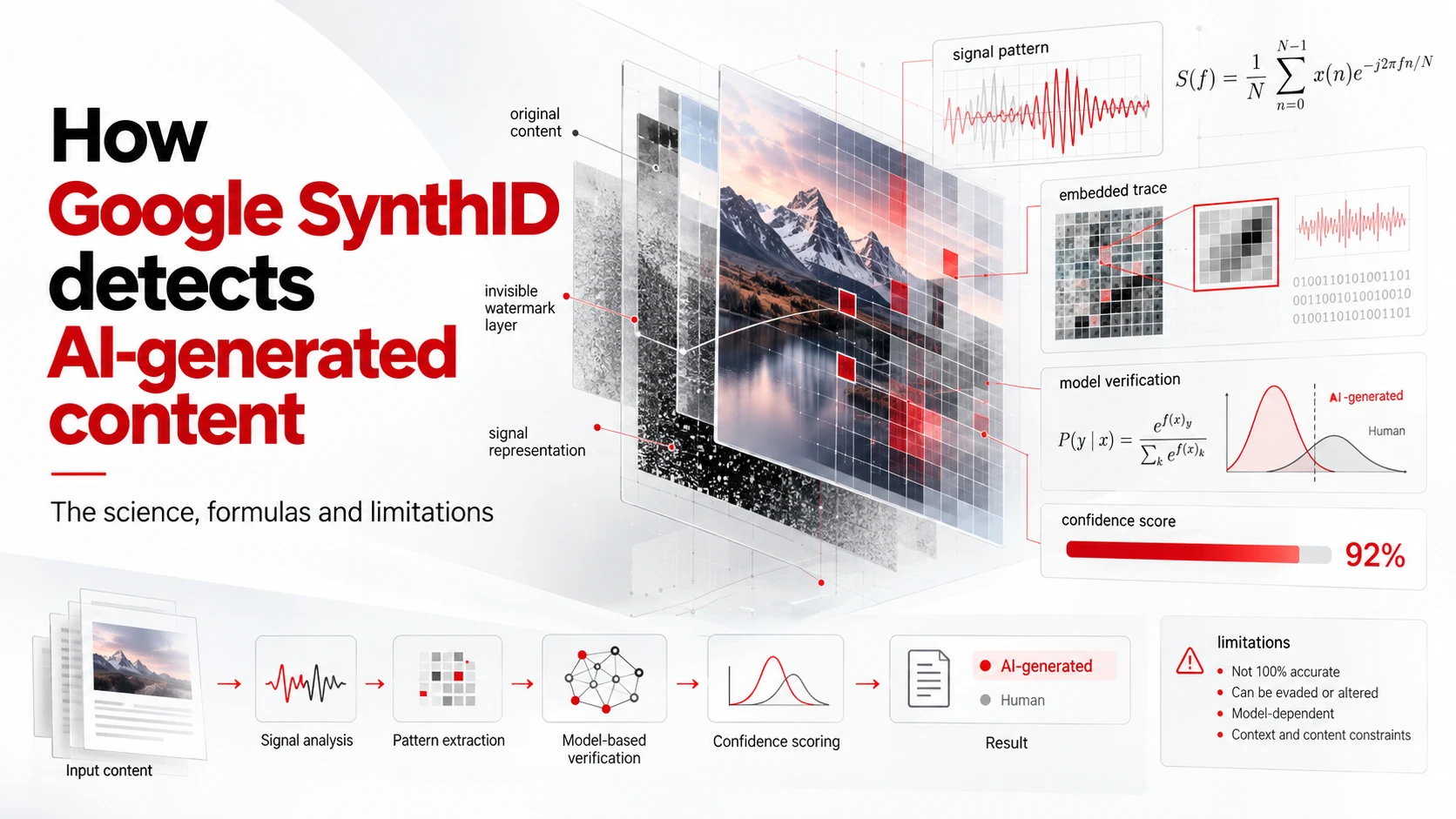
An AI detector and a humaniser do different jobs. A detector assesses content origin or watermark evidence; a humaniser improves writing. Google SynthID Text uses keyed statistical watermark signals inserted during generation, and it does not work by checking a list of suspicious phrases. Our companion guide explains how Google SynthID detects AI-generated content.
Why AI drafts can feel generic
Common weaknesses include introductions that delay the answer, repetitive transitions, unfounded confidence, generic business jargon, missing examples and no original perspective. Fluency can disguise all of these problems.
"Content quality is essential for online success" is hard to dispute and not useful by itself. A stronger explanation asks whether the page answers the question, supports its claims, explains practical steps and gives the reader a meaningful next action.
Not every formal phrase is bad. Keep necessary terms such as canonical URL, tokenization and structured data, then explain them when the audience needs help.
Google's guidance on AI-assisted content
Google's Search guidance does not say that using AI automatically disqualifies a page. It prioritises helpful, reliable, people-first content. Creating large volumes of low-value pages mainly to manipulate rankings can violate the scaled content abuse policy.
Google also encourages publishers to consider who created the content, how it was made and why it exists. Use these questions as editorial safeguards, not as a ranking formula.
There is no published, universal Google "humanisation score". Nor is there a reliable promise that a word-rewriting tool can make content undetectable. Good content starts with a real purpose and accountable review.
The RankNexus eight-step humanisation framework
This is a RankNexus editorial framework based on our humaniser methodology. It is not an official Google ranking algorithm.
Step 1: define the reader
Identify the target audience, its problem, its prior knowledge and the action the reader should be able to take.
| Before | After |
|---|---|
| "AI search visibility is an emerging paradigm in digital transformation." | "When someone asks an AI assistant to recommend a product in your category, does your brand appear? AI visibility analysis explores that question." |
Step 2: lock facts before rewriting
Protect names, numbers, dates, quotations, technical definitions, formulas, attribution and meaningful qualifications.
| Version | Text |
|---|---|
| Original | "The experiment involved 240 respondents and ran for 14 days." |
| Safe | "Over 14 days, the experiment collected responses from 240 participants." |
| Unsafe | "The month-long experiment surveyed more than 250 people." |
Step 3: remove filler, not substance
Replace generic observations with concrete actions. Never delete necessary caution, evidence, definitions or specialist terms just because they sound formal.
Step 4: improve rhythm naturally
Mix sentence lengths when the logic calls for it, and connect ideas clearly. Do not introduce typos, slang, awkward fragments or unnatural punctuation to imitate human writing.
Step 5: include useful examples
Examples should clarify why something matters and how it works. Label hypothetical examples. Never fabricate customer experiences, case studies or statistics.
Step 6: add genuine information gain
Contribute original research, an accurate comparison, expert interpretation, a practical checklist, a diagram or a documented case. A paraphrase of ten competitor articles is not automatically a valuable new article.
Step 7: verify claims and sources
Check factual assertions against the relevant primary documents. Avoid unsupported "always", "never" and universal ranking promises. Correct or qualify statements you cannot verify.
Step 8: complete human editorial approval
Read the whole article for logic, tone, audience fit, factual accuracy, repetition, accessibility and a useful conclusion. A named author should review and approve content attributed to them.
Five before-and-after editing examples
Example A: SEO
| Before | "SEO is an essential component of the digital marketing landscape, enabling organizations to enhance visibility and achieve sustainable business growth." |
| After | "Your website can look great and still attract few visitors. SEO helps you understand what people search for, whether your pages answer those questions and what stops search engines from finding your content." |
| Why | It starts with a recognisable problem and gives SEO a concrete purpose. |
Example B: AI visibility
| Before | "AI visibility is a revolutionary framework that empowers businesses to optimize their digital footprint across intelligent discovery ecosystems." |
| After | "Customers ask AI tools for recommendations and explanations. AI visibility helps brands check whether they appear in relevant answers, how they are described and which sources are referenced." |
| Why | It explains the concept without promotional fog. |
Example C: product description
| Before | "Our cutting-edge analytics platform delivers robust, next-generation capabilities that empower businesses to unlock actionable insights." |
| After | "See which pages bring visitors to your website, where the traffic comes from and which content needs attention, in one reporting view." |
| Why | It describes a tangible benefit. Use it only if the product truly supports these capabilities. |
Example D: marketing email
| Before | "We are delighted to inform you that our comprehensive range of innovative solutions is now available to optimize your organizational requirements." |
| After | "We've added a reporting feature that brings campaign performance into one view. Here's what it shows and how to get started." |
| Why | It is more direct. The feature described here is hypothetical, so verify it before sending. |
Example E: technical explanation
| Before | "Watermark-based AI detection leverages sophisticated stochastic computational methodologies to facilitate the identification of machine-generated linguistic artifacts." |
| After | "Some AI systems embed an invisible statistical watermark while generating text. A compatible detector checks for that pattern later. A missing watermark does not prove human authorship." |
| Why | It keeps the key technical meaning while cutting needless jargon. |
Humanising content for SEO
Match the actual search intent. Someone searching "how to humanise AI content" expects practical steps, examples, pitfalls and publishing guidance. Deliver those first rather than spending several screens on the history of AI.
Use the main keyword naturally in the title, the H1 and the relevant sections. Related phrases can appear where they genuinely fit. Do not repeat a target keyword in every paragraph.
Make headings descriptive. "How to humanise AI content for SEO" is clearer than "Unlocking the future of optimization". Link to relevant pages with descriptive anchor text, and check that those links actually exist.
Keep precise technical terminology where it is needed. Replacing "canonical URL" with "main internet address" obscures the meaning. Improve the explanation, not the precision.
Make the page easy to scan: paragraphs, tables and diagrams should clarify the topic. Every formatting element should earn its place.
Humanising content for AEO
Answer Engine Optimization (AEO) is about answering questions clearly and accurately. Place concise answers next to the questions they resolve, then give the supporting detail.
Q: Can AI-generated content rank in Google?
A: Yes. Google's Search guidance assesses content usefulness and policy compliance rather than automatically rejecting AI-assisted writing. Low-value content made at scale to manipulate rankings may violate spam policies.
An AEO checklist:
- Answer the core question promptly.
- Define unfamiliar terms.
- Include the essential exceptions and caveats.
- Link to reliable evidence for contestable claims.
- Write FAQs for genuine follow-up questions, not for keyword stuffing.
Clear answers can help accessibility and understanding. They do not guarantee that an AI-generated answer will cite your page.
Humanising content for GEO
Generative Engine Optimization (GEO) is about making distinctive, reliable content easier to discover and, potentially, to reference in AI answer experiences. It should build on sound SEO, not replace it. Our guide to query fan-out explains how AI engines choose the pages they cite.
Useful practices include publishing source-backed explanations, documenting experiments, keeping business information consistent, creating original comparisons and making essential content reachable for crawlers and readers.
Do not fabricate expert quotes, case-study numbers or third-party endorsements. Do not treat artificial text chunking, manufactured mentions or special AI files as guaranteed visibility shortcuts.
A page offering a documented test and its limitations gives more value than a page recycling widely available claims. Greater value is a reason to publish; it is not a promise of citation.
An integrated SEO, AEO and GEO example
Suppose a business drafts "How to improve website traffic". The original draft repeats advice to publish good content, use keywords and build backlinks. Here is how each lens revises it:
| Lens | Revision |
|---|---|
| SEO | Show readers how to establish a baseline, tell low visibility apart from weak clicks, inspect search queries and prioritise page improvements. |
| AEO | Answer the main question immediately: "First determine whether traffic is limited by search demand, search visibility or click-through rate. Each calls for a different response." |
| GEO | Provide a verified diagnostic framework, precise definitions, authoritative citations and original data if it genuinely exists. |
| Humanisation | Explain the workflow with everyday examples and remove redundant promotional language. |
The result is better because it helps a person investigate a real problem.
Humaniser quality assurance checklist
- Reader and intent explicitly defined
- Verified facts, numbers, names and dates preserved
- No fictional quotes, experiences or research
- Generic filler replaced by useful information
- Clear structure and a natural, appropriate voice
- Original information or a helpful practical application
- Direct answers to the important questions
- Sources that support the relevant assertions
- Accurate title, headings, metadata and internal links
- Accessible content and a working canonical URL
- Legal, medical and financial claims reviewed where necessary
- A responsible editor or author approved the final copy
Do not turn the checklist into a false formula for Google rankings. Scores can guide internal review; they cannot guarantee ranking or citation.
Common humanisation mistakes
| Mistake | Fix |
|---|---|
| Blind synonym replacement | Improve meaning, relevance and readability rather than changing random words. |
| Adding deliberate grammar errors | Keep grammar and facts correct. Natural language can still be polished. |
| Removing citations to seem informal | Keep the evidence and explain why it matters. |
| Inventing firsthand experience | Label hypothetical examples and document actual tests. |
| Changing technical meaning | Protect figures, conditions, terminology and caveats. |
| Promising "undetectable AI content" | Separate editorial improvement from watermark verification. |
| Excessive keyword repetition | Match reader intent with precise, natural topic coverage. |
A responsible production workflow
- Create a research-backed content brief.
- Draft using approved sources.
- Identify and verify the claims.
- Lock meaning-critical facts and citations.
- Rewrite for clarity, audience and original value.
- Review intent, metadata, accessibility and internal links.
- Add direct answers and useful evidence for AEO and GEO.
- Get final human approval.
- Publish, measure search performance and revise when warranted.
If a provenance tool is connected, report its findings separately from editorial quality. Genuine SynthID Text verification needs compatible keys, model settings and a calibrated detector. Generic writing-pattern scores are not Google's watermark evidence.
The RankNexus perspective
At RankNexus.ai, we believe a publishing workflow should do more than create more pages. It should help teams make content accurate, accessible and useful for people searching on Google and finding information through AI-powered systems.
SEO improves relevance and discoverability. AEO encourages direct answers. GEO emphasises trustworthy, distinctive information with clear sources. Humanisation makes the communication work for real readers. No single score can stand in for these separate responsibilities.
Conclusion
Humanising AI content is an editorial process, not a game of replacing words until a detector changes its mind. Make the article accurate, understandable, useful and distinct. That serves readers whether they arrive through traditional search or an AI-powered answer.
Don't just make AI content sound human. Make it useful enough that a human would want to read it.
Previous in this series: How Google SynthID detects AI-generated content: the science, formulas and limitations.
Sources and recommended reading
- Google Search Central: Creating helpful, reliable, people-first content
- Google Search Central: Using generative AI content
- Google Search Central: Guide to optimizing for generative AI features
- Google Search Central: AI features and your website
- Google DeepMind: SynthID
- Google AI for Developers: SynthID tools for watermarking and detecting LLM-generated text
- Google Search Central: Article structured data
All examples in this article are illustrative unless described as measured or verified case studies.
Frequently asked questions
What is the best way to humanise AI content?
Define the reader, verify the facts, remove filler, add useful examples and original insight, then complete an editorial review.
Can Google rank AI-assisted articles?
Yes. AI assistance is not automatically disqualifying; quality and spam-policy compliance remain important.
Does rewriting remove a SynthID watermark?
Editing may affect detection, but there is no universal guarantee. Watermark detection is not based on generic AI phrases.
Is a humaniser the same as an AI detector?
No. One improves writing; the other attempts to evaluate content origin or watermark evidence.
Does humanisation guarantee better SEO rankings?
No. It can improve clarity and relevance, but rankings depend on many factors.
What is the difference between SEO, AEO and GEO?
SEO concerns search discoverability, AEO clear answers, and GEO distinctive, verifiable information that AI systems may reference.
Can AI-assisted content be original?
Yes, when it includes genuine original analysis, verified research or expert judgement rather than paraphrasing.
Should every AI draft pass through a human editor?
For publishable branded content, accountable human review is a sound quality safeguard.
What should a humaniser never change?
Verified facts, named entities, dates, numbers, quotations, source attribution, technical meaning and necessary caveats.
Can you guarantee AI writing becomes 100% human?
No. That claim confuses writing quality with uncertain judgements about authorship.
Want this done for your site?
Run a free audit and see exactly what to fix for Google and AI search.