Gemini 4 Argon Access: Who Can Use It Now

If you're reading up on gemini 4 argon access, you want one answer: can my team use it, and from when? The short version is that access is staged. Google releases these models in waves: a closed preview, then an expanded developer tier, then general availability. Where Argon sits in that cycle depends on when you check, so treat any blog post, including this one, as a map rather than a timetable.
Can developers and businesses use Gemini 4 Argon yet?
Gemini 4 Argon access is typically limited at launch. Developers usually reach new Gemini releases first through a preview tier in Google AI Studio or the Gemini API, often behind a waitlist. Most businesses wait for general availability, when the model gets a stable version string, published pricing and a service level you can build on.
Google has followed this pattern across the Gemini family. A model appears as an experimental or preview build, carries no guarantee of continuous availability, and can change or vanish with little notice. That phase suits prototyping, not a live checkout flow. When it graduates to general availability, you get a fixed model name, documented rate limits and quota you can request.
Note: Model code-names like "Argon" are often internal or pre-release labels. The name you call in production may differ from the name in early coverage. Always pin to the exact version string in Google's docs.
How Google rolls out a new Gemini model
Google ships Gemini models through roughly four stages, each with its own access rules and risk profile. Knowing the stage tells you whether you can plan a launch around it or should keep it in a sandbox.
| Stage | Who gets in | What you can rely on |
|---|---|---|
| Closed preview | Invited partners, waitlist | Nothing; can change daily |
| Public preview / experimental | Developers via AI Studio or API | Testing only, no SLA |
| General availability | Anyone with a billing account | Stable version, quotas, pricing |
| Enterprise tier | Vertex AI customers | Data controls, support, SLA |
Say you run a 40-person SaaS firm in Pune and want Argon to power a support assistant. In closed or public preview you can wire up a demo and measure answer quality. You should not route real customer tickets through it until it hits general availability, because a silent model change could break your prompts overnight.
What each access tier actually gives you
The tier you land in decides your rate limits, your data handling and whether you can pay for more capacity.
- Free preview tier: low daily request caps, prompts and outputs may be used to improve the service, no production guarantees.
- Paid API tier: higher quotas, billing per token, data handling governed by the Gemini API terms.
- Vertex AI (enterprise): runs inside Google Cloud, with region controls, VPC options and contractual data terms that matter for GST-registered businesses handling customer records.
If your use case touches personal data of Indian users, the enterprise route through Vertex AI gives you the data-residency and processing controls your compliance team will ask about. The free preview does not.
Where to check the real access status
The only reliable source is Google's own documentation, because rollout status changes week to week. Start with the model list in the Gemini API documentation, which shows every model currently callable, its version string and whether it is preview or stable.
Two quick checks tell you where things stand:
- Open Google AI Studio and look at the model dropdown. If an Argon build is selectable, developer preview access is open.
- Check the Vertex AI Model Garden in Google Cloud Console. A model listed there with pricing is at or near general availability for business use.
If the name appears in neither, access is still closed and any "get access now" link you find off-platform is not from Google.
Watch out: Be wary of third-party sites selling early Gemini access or API credentials. Google distributes access only through Google AI Studio, the Gemini API and Vertex AI. Credentials bought elsewhere are a security and billing risk.
Should your business wait or build now?
Build on a preview model only if you can absorb breakage; wait for general availability if the feature touches revenue or customer data. That rule covers most Indian SMBs. A model in preview can change its outputs, pricing or availability with no notice, and you carry that risk.
There's a sensible middle path. Prototype on the preview tier to learn what the model does well, document your prompts and evaluation set, then port to the stable version the day it ships. You lose nothing and you're ready on launch day.
For most businesses, the more pressing question isn't which Gemini version you can call, it's whether AI answer engines cite your business at all. That depends on your content and structured data, not on access to the newest model. Our guide to getting cited by ChatGPT, Gemini and Perplexity walks through what actually moves that needle, and the get cited by Gemini academy lesson goes deeper on Gemini specifically.
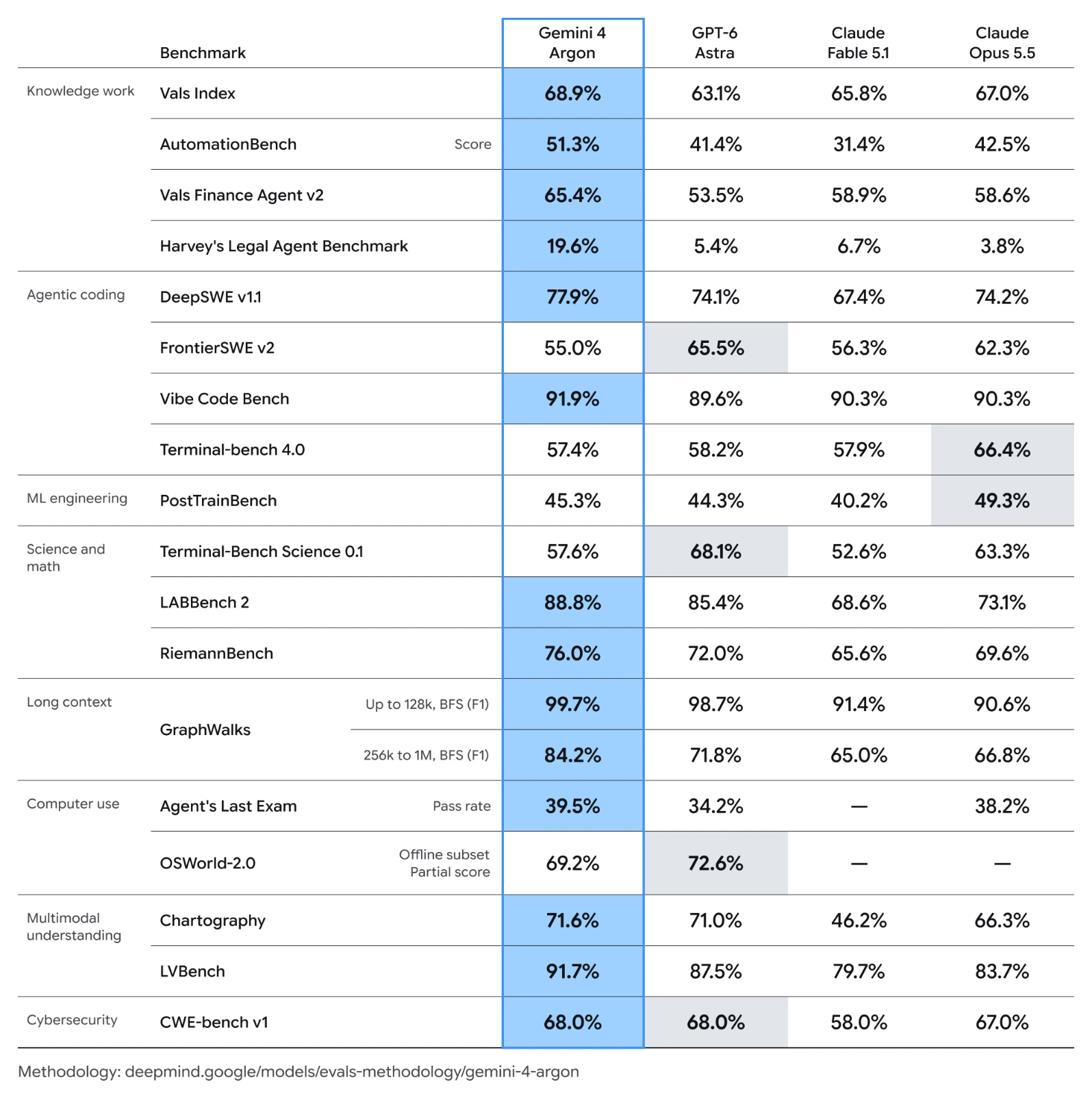
To support Gemini 4 Argon across longer, high-complexity workflows, we've expanded its output token limit from 64K to an industry-leading 1M tokens. Providing the model with enough runway to process deep reasoning and generate hundreds of thousands of tokens within a single trajectory enables it to solve intricate, end-to-end engineering and enterprise challenges in a single pass.
What this means for AI visibility, not just API access
Access to a model and visibility inside its answers are two different goals. You might never call the Gemini 4 Argon API and still care enormously whether Gemini names your company when someone asks it for recommendations in your category.
That visibility comes from clean, structured, well-sourced content that an answer engine can lift with confidence. For a local firm, that means accurate business schema, a consistent entity across the web and pages that answer real questions plainly. Our writing on AI visibility for local business covers the groundwork, and if you run a small operation, the SEO for small business guide pairs with it.
Whichever Gemini version ships next, the businesses that get named in its answers are the ones whose content was already easy to cite. Start there while you wait for the access email.
Run a free audit to see how often AI answer engines already mention your business, and where to fix it.
Keep up with what we publish next: add RankNexus to your preferred sources on Google.
Frequently asked questions
Is Gemini 4 Argon available to developers and businesses yet, or is it limited access?
At launch, access is usually limited. Developers typically reach new Gemini builds first through a preview tier in Google AI Studio or the Gemini API, often behind a waitlist. Businesses generally wait for general availability, when the model gets a stable version and published pricing. Check Google's model documentation for the current status before planning any build.
How do I request access to a Gemini preview model?
You request access through Google's official channels only: sign in to Google AI Studio and check the model dropdown, or join any waitlist Google posts in its Gemini API documentation. There's no separate purchase. If a model appears in the AI Studio list or the Vertex AI Model Garden, you can start calling it from your account.
Why can't I see Gemini 4 Argon in Google AI Studio?
If the model isn't in your AI Studio dropdown, access is still closed in your region or account, or the build hasn't reached public preview. Rollouts are staged, so some accounts get it before others. Confirm the exact model name in Google's documentation, because the public version string may differ from the code-name used in early coverage.
Can I use a Gemini preview model in production?
You can technically call it, but you shouldn't route revenue or customer-facing flows through a preview model. Preview builds carry no service level and can change outputs, pricing or availability without notice. Prototype on preview, then switch to the general-availability version once it ships with a stable version string and documented quotas.
What's the difference between the Gemini API and Vertex AI for business access?
The Gemini API is the quicker route for developers, with free and paid tiers billed per token. Vertex AI runs inside Google Cloud and adds region controls, VPC options and contractual data terms that enterprise and compliance teams need. If you handle personal data of Indian customers, Vertex AI gives you the data-handling controls the direct API tier does not.
Does Gemini 4 Argon access cost money in India?
Preview tiers are often free with low daily caps, while paid API use is billed per token and charged in your Google Cloud or AI Studio account currency. Pricing for any specific model only becomes firm at general availability. Confirm current rates on Google's official pricing page, as preview models may have no published price at all.
Is it safe to buy Gemini API access from a third-party seller?
No. Google distributes Gemini access only through Google AI Studio, the Gemini API and Vertex AI. Any third party selling early access, API keys or guaranteed slots is a security and billing risk, and may breach Google's terms. Use only keys generated in your own Google account, and rotate any key that has been exposed.
Will getting Gemini API access help my business show up in Gemini's answers?
No, those are separate things. API access lets you build with the model; being cited in Gemini's answers depends on your content, structured data and consistent business entity across the web. You can appear in Gemini answers without ever using the API. Focus on clean schema and clear, sourced pages that an answer engine can quote confidently.
How will I know when Gemini 4 Argon reaches general availability?
General availability shows up as a stable version string in Google's model documentation, a listing in the Vertex AI Model Garden with pricing, and a published rate limit you can request quota against. When those appear together, the model is safe to build on. Until then, treat any build as a preview with no guarantees.
Want this done for your site?
Run a free audit and see exactly what to fix for Google and AI search.