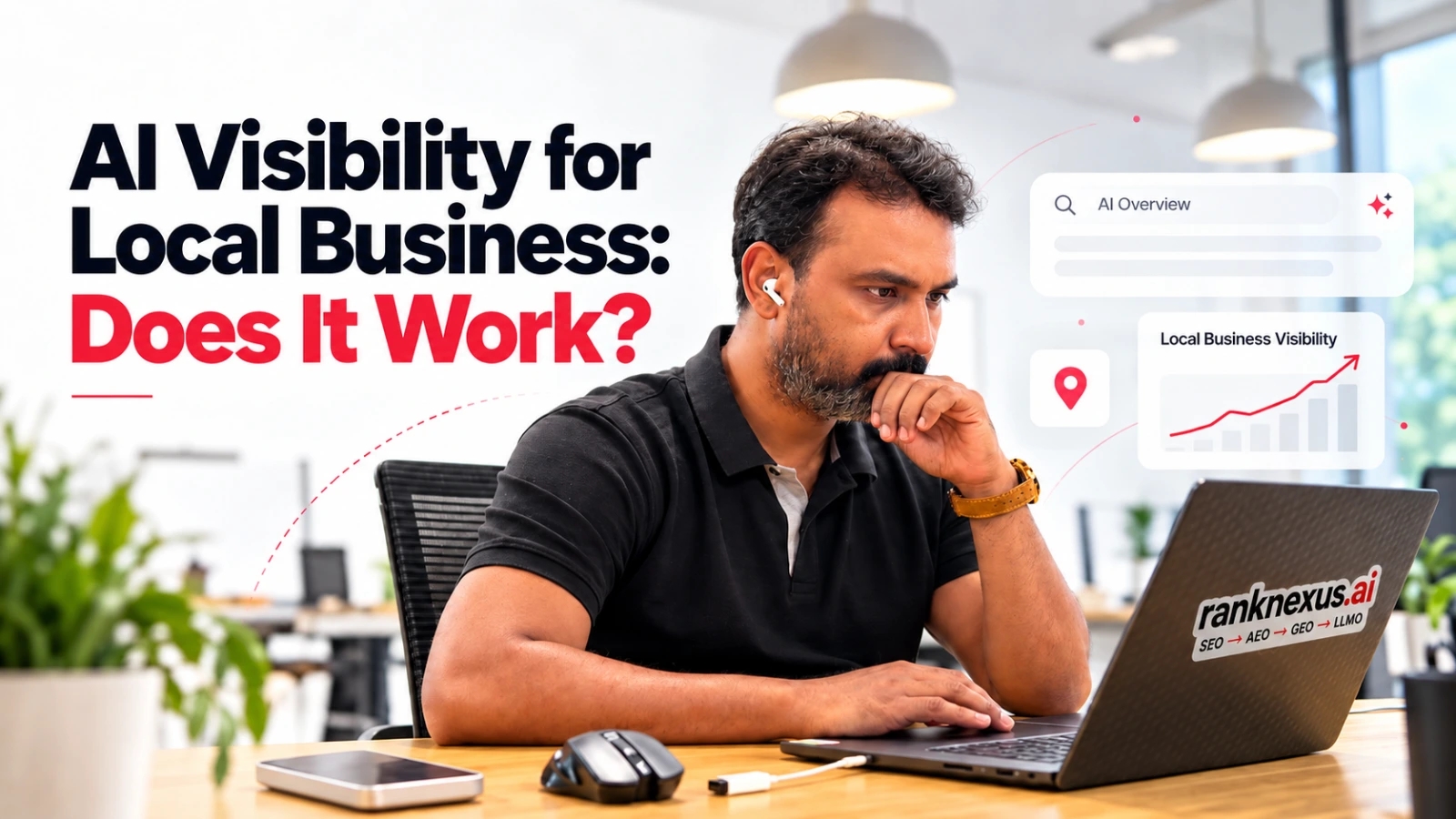
AI Visibility for Local Business: Does It Work?
Say you run a dental clinic in Pune, or a two-branch bakery in Coimbatore. Someone opens ChatGPT and types "best root canal near me" or asks Gemini for a birthday cake shop that delivers. Do you show up? Most AI visibility advice assumes you sell software or ship parcels nationwide. That leaves local owners guessing whether any of it applies to them. It does, and in some ways the fit is tighter.
Do AI Visibility Tools Work for Local Businesses, Not Just SaaS and Ecommerce?
Yes. ai visibility for local business works, and often more reliably than for SaaS, because local queries carry sharp intent and AI engines pull local answers from sources you already control: your Google Business Profile, reviews, directory citations and website. When someone asks an AI assistant for a service "near me", the engine leans on the same signals that feed the Google map pack, so cleaning those up moves you in both places.
The difference is not whether the tools work. It is which levers matter. A SaaS company chases mentions in comparison articles and Reddit threads. A local business wins on profile accuracy, review volume, category selection and consistent name, address and phone details across the web.
Key facts
- Main sources AI uses locally
- Google Business Profile, reviews, citations, website schema
- What to fix first
- NAP consistency and GBP categories
- Typical result window
- weeks, not days
- Geography
- matters more than for SaaS or ecommerce
Why local intent suits AI engines better
Local queries are unusually easy for AI to answer well, which is exactly why they get answered. "Emergency electrician in Andheri" has one obvious goal: find someone nearby who can come now. There is no long research phase, no feature comparison, no cart. The engine just needs a shortlist of real businesses with contact details and proof they are any good.
That proof already sits in structured, machine-readable places. Google Business Profile publishes your hours, category, address and rating in a format engines read cleanly. Reviews give sentiment. Citations on Justdial, Sulekha, IndiaMART and your local chamber directory confirm you exist and are consistent.
A physiotherapy centre with 180 Google reviews at 4.7 stars, a correctly set main category, and matching NAP across eight directories gives an AI assistant everything it needs to recommend confidently. A newer clinic with 11 reviews and a wrong category on two directories gives it reason to hesitate.
What changes versus SaaS and ecommerce
The playbook shifts hard depending on what you sell. SaaS visibility lives in editorial content and third-party mentions. Ecommerce visibility lives in product data, pricing feeds and category pages. Local visibility lives in your profile and your reputation.
| Signal | Local business | SaaS/ecommerce |
|---|---|---|
| Top source | Google Business Profile, reviews | Editorial mentions, product feeds |
| Geography | Central to every query | Rarely relevant |
| Reviews | Decisive | Helpful, not decisive |
| Content library | Small, service-focused | Large, keyword-driven |
| Schema type | LocalBusiness, Review | Product, Organization, FAQ |
This is why generic AI visibility tools sometimes feel useless to local owners: they measure the wrong things. A tool that tracks brand mentions across 40 blogs tells a plumber nothing. A tool that checks whether ChatGPT and Gemini recommend you for "plumber near [your area]" and flags a broken citation tells them plenty.
4
signals that decide most local AI answers: profile accuracy, reviews, categories, citation consistency.
The five things that actually move local AI visibility
Start with the foundations that AI engines read directly, in this order. Each one is cheap to fix and compounds.
- Google Business Profile accuracy: correct main category, complete hours, real photos, a description written for humans. Run a quick check with the GMB audit tool before anything else.
- NAP consistency: your name, address and phone must match character-for-character across every directory. A comma or an old suite number breaks trust. The NAP consistency checker surfaces mismatches fast.
- Review volume and freshness: recent reviews weigh more. Ask every satisfied customer, and reply to each one. AI engines read review text, not just the star average.
- Local citations: presence on the directories that matter in India, confirmed with the local citation checker.
- LocalBusiness schema on your site: mark up your address, hours and services so engines parse them without guessing.
Pick the main category carefully. A pet grooming service listed under "pet store" will lose "dog groomer near me" to a rival with the exact category. If you are unsure, the GMB category finder narrows it down.
How to check whether AI already recommends you
Test it yourself before you pay for anything. Open ChatGPT, Gemini and Perplexity and ask the questions your customers ask: "best [your service] in [your locality]", "[service] open now near [area]", "affordable [service] [city]". Note whether you appear, who does, and what the engine says about them.
Then check the underlying signals. Are you in the Google map pack for those terms? You can confirm with the map pack rank checker. If you rank in the map pack but not in AI answers, the gap is usually thin reviews or missing schema. If you fail both, start with the profile.
Google's own Business Profile guidelines spell out what earns visibility and what gets a listing suspended, and AI engines lean on that same data, so following them is not optional.
Watch out: Buying fake reviews or stuffing keywords into your business name breaks Google's guidelines and can get your profile suspended, which removes you from map pack and AI answers at once.
Where local businesses waste effort
The common mistake is copying SaaS tactics that do not transfer. Writing 30 blog posts targeting broad keywords rarely helps a single-location salon; the engine wants proximity and proof, not a content library. Chasing national backlinks does little when your entire market is a 5 km radius.
Another trap is treating AI visibility as separate from local SEO. It is not. The two run on the same fuel. Fix your profile, reviews and citations and you improve both your map pack position and your odds of being named by an assistant. Our local business use cases show how the same fixes serve both channels.
For a two-branch business, keep this trap in mind: a shared phone number or a single profile for both locations confuses engines. Each branch needs its own profile, its own reviews and its own consistent citations, or AI answers will merge or drop one of them.
Is it worth the spend for a small local business?
For most local businesses the cost is low and the return is direct, because the same work lifts your map pack ranking, your click-through and your AI answer presence together. You are not funding a separate channel; you are fixing the profile that already drives your calls and walk-ins.
Start free. Audit your profile, check your NAP and test three AI queries this week. If those turn up broken citations or a wrong category, you have found paying work that costs nothing to identify. Run a free audit with RankNexus and see where you actually stand.
To see more from RankNexus when you search, add us as a preferred source on Google. It takes one click.
Frequently asked questions
Do AI visibility tools work for local businesses or only SaaS and ecommerce?
They work for local businesses, often more directly than for SaaS. Local AI answers pull from Google Business Profile, reviews and citations, which you control. The tactics differ: you optimise your profile, reviews, categories and NAP consistency instead of chasing editorial mentions or product feeds. Generic mention-tracking tools feel useless locally because they measure the wrong signals.
Why does my business show in Google Maps but not in ChatGPT answers?
Ranking in the map pack proves your location signals are fine, but AI engines also weigh review text, schema and citation depth. If you appear in Maps but not in AI answers, the usual gaps are too few recent reviews, missing LocalBusiness schema on your site, or inconsistent details across directories that make the engine hesitant to name you.
Do I need a website for AI to recommend my local business?
Not strictly, since AI engines can recommend you from Google Business Profile and citations alone. But a website with LocalBusiness schema gives engines cleaner, richer data about your hours, services and area, which improves how often and how accurately you get named. A one-page site with correct schema beats no site at all.
How many Google reviews do I need before AI recommends me?
There is no fixed number. AI engines weigh volume, recency, rating and review text together. A clinic with 40 recent, detailed reviews often beats one with 200 old ones. Focus on a steady stream of fresh reviews and reply to each, since engines read the conversation, not just the star average.
Will optimising for AI visibility hurt my normal local SEO?
No, they run on the same signals. Fixing your Google Business Profile, cleaning up NAP consistency, growing reviews and adding schema improves your map pack ranking and your AI answer presence at once. You are not splitting effort across two channels; you are strengthening one profile that feeds both.
My business has two branches. How do I stop AI merging them?
Give each branch its own Google Business Profile, its own phone number where possible, and its own consistent citations across directories. A shared number or a single listing for both locations confuses engines, causing them to merge the branches or drop one from AI answers. Keep review collection separate per branch too.
Does the wrong GBP category really affect AI recommendations?
Yes, significantly. AI engines and the map pack both use your primary category to match queries. A dog groomer listed under "pet store" will lose "groomer near me" to a rival with the exact category set. Check your primary and secondary categories carefully, since fixing this alone can change which queries you appear for.
How fast will I see results after fixing my local signals?
Usually weeks, not days. Google needs time to reflect profile and citation changes, and AI engines refresh their sources on their own schedules. Review growth is the slowest lever because it depends on real customers. Foundational fixes like category corrections and schema tend to show up sooner than review-driven changes.
Are paid AI visibility tools worth it for a single-location business?
Often yes, because they automate checks you would otherwise do by hand across many directories and AI engines. That said, start with free audits of your profile, NAP and three test queries. If those reveal broken citations or a wrong category, you have already found the paying work, and a tool then keeps it monitored.
Want this done for your site?
Run a free audit and see exactly what to fix for Google and AI search.